---
title: How to Increase Patient Flow and Volume in Your Dental Office
description: Find gaps between patient inquiries, bookings, and kept appointments. Review calls, scheduling, reminders, and follow-up to decide what to improve first.
image: https://blog.titanwebagency.com/hubfs/patient-flow-cover-2026.png
---
[](https://titanwebagency.com/)
- About
[About Tyson DownsRead more about Tyson Downs](https://titanwebagency.com/about-us/tyson-downs/) [AboutRead more about the team at Titan Web Agency](https://titanwebagency.com/about-us/) [Our ReviewsWhat some of our clients have to say](https://titanwebagency.com/reviews/) [ResultsRead about results we've gotten for our clients](https://titanwebagency.com/results/) [Problems We SolveRead about some of the problems we can help you solve](https://titanwebagency.com/dental-marketing-problems/) [PortfolioCheck out our work](https://titanwebagency.com/portfolio/) [PodcastListen to our podcast](https://titanwebagency.com/podcast/)
Have questions?
Schedule a discovery call to discuss your practice goals.
Schedule Now
- [Blog](https://blog.titanwebagency.com/)
- Resources
Resources
[Dental Marketing GuideSix marketing channels to attract, convert, and retain more patients](https://titanwebagency.com/dental-marketing-guide/) [Running a Dental PracticeThe business disciplines that separate practices that grow from ones that plateau](https://titanwebagency.com/running-a-dental-practice/) [How to Get More Dental PatientsAttract, convert, and keep the patients your practice needs to grow](https://titanwebagency.com/attract-dental-patients/) [Dental Practice TransitionsEverything you need to know about buying, selling, relocating, or starting a practice](https://titanwebagency.com/dental-practice-transitions/)
Have questions?
Schedule a discovery call to discuss your practice goals.
Schedule Now
- Services
Services
[AI Search OptimizationHelp my practice appear in the AIO (AI Overviews), ChatGPT, Claude, Gemini, and more.](https://titanwebagency.com/services/ai-geo/) [Local SEOIncrease my local rankings in Google](https://titanwebagency.com/services/local-seo/) [Pay Per Click ManagementGet better results from Google, Bing, or Meta Ads.](https://titanwebagency.com/services/pay-per-click/) [Web DesignBuild me an awesome website](https://titanwebagency.com/services/web-design/) [Branding & RebrandingBranding or rebranding, we can handle it for you](https://titanwebagency.com/services/branding-rebranding/) [Logo DesignCreate a memorable & brand-able Logo](https://titanwebagency.com/services/logo-design/) [Review ManagementImprove my online reputation, help me get more positive reviews](https://titanwebagency.com/services/review-management/) [Website Hosting & MaintenanceHost, secure, & maintain my website](https://titanwebagency.com/services/website-maintenance/) [See all services →](https://titanwebagency.com/services/)
Have questions?
Schedule a discovery call to discuss your practice goals.
Schedule Now
[(801) 783-3101](tel:8017833101) [Get in touch](https://titanwebagency.com/contact/)
About
[About Tyson DownsRead more about Tyson Downs](https://titanwebagency.com/about-us/tyson-downs/) [AboutRead more about the team at Titan Web Agency](https://titanwebagency.com/about-us/) [Our ReviewsWhat some of our clients have to say](https://titanwebagency.com/reviews/) [ResultsRead about results we've gotten for our clients](https://titanwebagency.com/results/) [Problems We SolveRead about some of the problems we can help you solve](https://titanwebagency.com/dental-marketing-problems/) [PortfolioCheck out our work](https://titanwebagency.com/portfolio/) [PodcastListen to our podcast](https://titanwebagency.com/podcast/)
[Blog](https://blog.titanwebagency.com/)
Resources
[Dental Marketing GuideSix marketing channels to attract, convert, and retain more patients](https://titanwebagency.com/dental-marketing-guide/) [Running a Dental PracticeThe business disciplines that separate practices that grow from ones that plateau](https://titanwebagency.com/running-a-dental-practice/) [How to Get More Dental PatientsAttract, convert, and keep the patients your practice needs to grow](https://titanwebagency.com/attract-dental-patients/) [Dental Practice TransitionsEverything you need to know about buying, selling, relocating, or starting a practice](https://titanwebagency.com/dental-practice-transitions/)
Services
[AI Search OptimizationHelp my practice appear in the AIO (AI Overviews), ChatGPT, Claude, Gemini, and more.](https://titanwebagency.com/services/ai-geo/) [Local SEOIncrease my local rankings in Google](https://titanwebagency.com/services/local-seo/) [Pay Per Click ManagementGet better results from Google, Bing, or Meta Ads.](https://titanwebagency.com/services/pay-per-click/) [Web DesignBuild me an awesome website](https://titanwebagency.com/services/web-design/) [Branding & RebrandingBranding or rebranding, we can handle it for you](https://titanwebagency.com/services/branding-rebranding/) [Logo DesignCreate a memorable & brand-able Logo](https://titanwebagency.com/services/logo-design/) [Review ManagementImprove my online reputation, help me get more positive reviews](https://titanwebagency.com/services/review-management/) [Website Hosting & MaintenanceHost, secure, & maintain my website](https://titanwebagency.com/services/website-maintenance/) [See all services →](https://titanwebagency.com/services/)
Have questions?
Schedule a discovery call to discuss your practice goals.
[Schedule Now](https://titanwebagency.com/contact/)
[Call (801) 783-3101](tel:8017833101) [Get in touch](https://titanwebagency.com/contact/)
×
Updated September 22, 2026 by [Tyson Downs](https://blog.titanwebagency.com/author/tyson-downs) [Leave a Comment](https://blog.titanwebagency.com/dentists-can-attract-patients#comments-listing)
# How to Increase Patient Flow in Your Dental Office
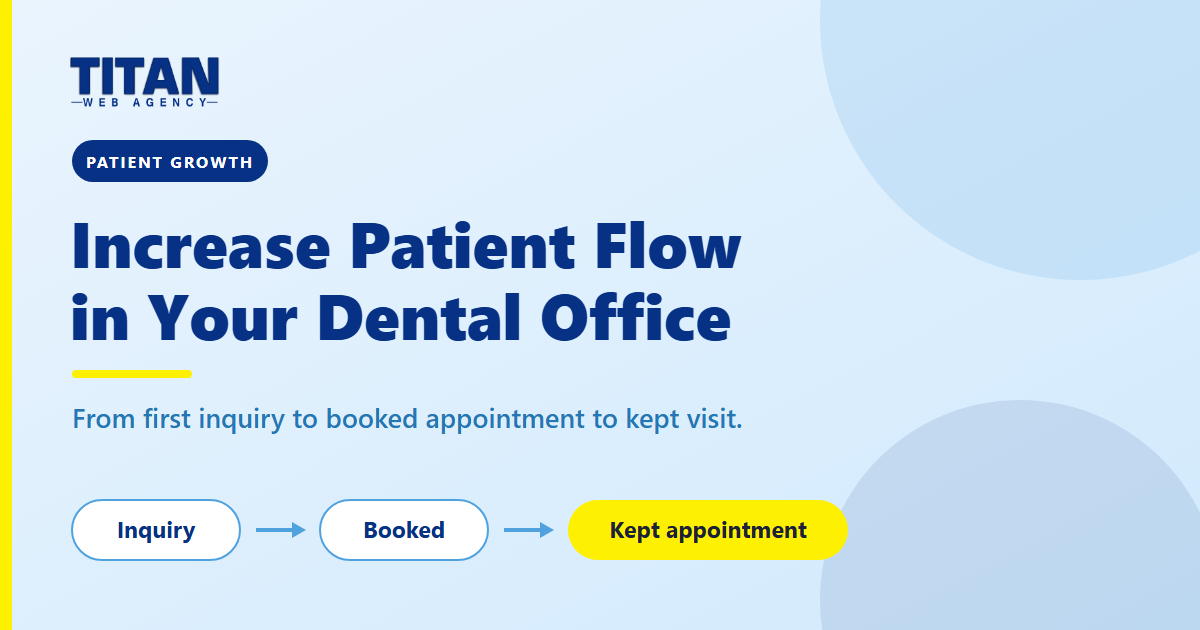
An open schedule doesn't tell you what went wrong. You may need more inquiries, but you may also have people calling without booking, patients canceling without rescheduling, or overdue patients with no return visit on the calendar.
To improve patient flow, follow the path from inquiry to booked appointment to completed visit. This guide shows you what to check at each step. For the broader plan to attract, convert, and retain patients, read our guide on [how to get more dental patients](https://titanwebagency.com/attract-dental-patients/).
Table of Contents
[Where Patient Flow Breaks Down](https://blog.titanwebagency.com/dentists-can-attract-patients#flow-breaks) [1. Make booking straightforward](https://blog.titanwebagency.com/dentists-can-attract-patients#book) [2. Find out why callers don't book](https://blog.titanwebagency.com/dentists-can-attract-patients#callers) [3. Make missed appointments easier to recover](https://blog.titanwebagency.com/dentists-can-attract-patients#missed) [4. Follow up with patients who are overdue](https://blog.titanwebagency.com/dentists-can-attract-patients#overdue) [5. Explain costs and payment options clearly](https://blog.titanwebagency.com/dentists-can-attract-patients#costs) [6. Review the results and choose the next fix](https://blog.titanwebagency.com/dentists-can-attract-patients#review) [Start with the gap in your schedule](https://blog.titanwebagency.com/dentists-can-attract-patients#summary)
## Key Takeaways
- Compare inquiries, bookings, and kept appointments over the same period.
- Separate new-patient booking problems from gaps in returning-patient care.
- Choose the next change from your practice's records, then measure what happens.
## Where Patient Flow Breaks Down
Start with your own records. How many new-patient inquiries did you receive? How many became appointments? How many of those patients attended? Then review returning patients separately.
You don't need to guess which part of the process needs attention. Use the same reporting period and definitions each time, and look for the point where patients stop taking the next step.
| Stage | What to record | Question to investigate |
| --- | --- | --- |
| Inquiry to booking | Qualified new-patient inquiries and resulting bookings | Why did someone who contacted us not schedule? |
| Booking to attendance | Kept appointments, cancellations, and no-shows | What happened after an appointment was canceled or missed? |
| Return visits | Patients due for care who have no appointment scheduled | Who needs follow-up, and who owns it? |
| Recommended treatment | Unscheduled treatment and the patient's stated reason | Is the obstacle cost, timing, an unanswered question, or something else? |
## 1. Make booking straightforward
Check the booking process on your phone. Can you find the office number, hours, address, and appointment options without hunting for them? Is it clear whether an online form books an appointment or only sends a request?
If patients can request appointments online, assign someone to review those requests and confirm the next step. Check after-hours messages too. An inquiry sitting in an inbox is still an inquiry until someone follows through.
Review appointment availability with your front desk. If callers regularly ask for times you cannot offer, record that reason instead of counting every unbooked call as a marketing problem.
Work through the booking process with your office manager. Check the phone number and appointment link on the pages patients use to contact you. Review what happens when a call goes unanswered, who receives an online request, and who covers that task when the usual person is out. Set a response expectation your team can actually meet, then check whether requests are being handled within it.
Separate a request from a confirmed appointment in your records. If your form only asks for a preferred time, the confirmation message should explain that your team still needs to arrange the visit. Patients should not have to guess whether they are on the schedule.
**What to measure:** For each unique new-patient inquiry, record when it arrived, when your team first responded, and whether it became a booking. Count repeat calls about the same request once. Keep unanswered calls that you have not identified separate from confirmed new-patient inquiries.
**How to use the results:** Unanswered requests point to a coverage or follow-up problem. Callers who reach your team but cannot find a suitable appointment point to an availability problem. Fix the issue your records show before assuming you need more website traffic.
## 2. Find out why callers don't book
Ask your front desk to record the outcome of new-patient inquiries. Did the person book, need a callback, ask about a service you don't offer, or decide the available appointment times would not work?
When someone asks about cost or insurance, answer what you can and explain what needs to be confirmed. Before ending the conversation, make sure the patient knows the next step and who will follow up.
Use the [New-Patient Phone Playbook](https://info.titanwebagency.com/phone-playbook) to support your team's training. Then track whether qualified inquiries become bookings and whether those patients attend. That is how you assess your own process.
Give your team a short, consistent list of outcomes to choose from: booked, callback needed, unavailable appointment time, service not offered, cost question unresolved, insurance question unresolved, declined, or reason unknown. Let staff add a brief note when the categories do not explain what happened. Do not guess why someone did not book.
For callbacks, record an owner and a due time. Review open callbacks before treating them as lost opportunities. A person waiting for an answer about an estimate is at a different stage from someone who has decided to go elsewhere.
**What to measure:** Divide unique qualified new-patient inquiries that became bookings by the number of unique qualified inquiries reviewed, then multiply by 100. Define "qualified" consistently: someone seeking care your practice provides and is able to accept. Document exclusions rather than changing the definition to improve the percentage.
**How to use the results:** Look at the reasons behind unbooked inquiries alongside the rate. If appointment availability is the issue, a new phone script alone will not solve it. If patients are waiting for answers, clarify who can answer those questions and how the front desk gets help.
## 3. Make missed appointments easier to recover
Check that patients receive the appointment date, time, location, and instructions for changing the booking. Make the reply or rescheduling process clear, and assign follow-up when a visit is missed.
A [Cochrane review of healthcare appointment reminders](https://www.cochrane.org/evidence/CD007458_mobile-phone-messaging-reminders-attendance-healthcare-appointments) found that text reminders improved attendance compared with no reminders. The review is older and covers healthcare settings, so it does not establish a specific improvement for your dental practice.
Track cancellations that get rescheduled separately from those that do not. For more detail, see our guide to [reducing patient no-show appointments](https://blog.titanwebagency.com/reduce-patient-no-show-appointments).
Start with the appointment record. Confirm that contact details are current and that your reminder system uses the patient's agreed contact method. Check whether messages are delivered and whether replies reach someone who can act on them. An automated reminder does not handle a request to change an appointment unless a person or a working scheduling process handles the response.
Agree on what happens when someone cancels. Your team should know who offers another appointment, who follows up if the patient cannot choose a time, and where that follow-up is recorded. Use the same approach for missed visits, with room for the patient's circumstances and the practice's policies.
**What to measure:** Record scheduled visits, visits kept, cancellations, and no-shows separately. For canceled or missed visits, also record whether a replacement appointment was booked and eventually attended. Choose a consistent follow-up window before comparing results.
**How to use the results:** More rescheduled appointments are encouraging, but they are not completed visits. Check attendance before concluding that follow-up is working. Also review whether cancellations cluster around a particular appointment type or time; investigate the pattern rather than assuming its cause.
## 4. Follow up with patients who are overdue
Review patients who are due for care and have no appointment scheduled, using the care interval recommended by your clinical team. Check contact preferences and assign someone to handle outreach and responses.
Record whether patients book and attend after you contact them. If they have moved, changed practices, or decided not to schedule, update your records instead of repeatedly sending the same message.
Our [dental patient reactivation guide](https://blog.titanwebagency.com/dental-patient-reactivation) covers outreach in more detail. For the ongoing process of helping patients stay connected with your office, see our [dental patient retention strategies](https://blog.titanwebagency.com/patient-retention-strategies).
Build the review list from your practice-management records. Include the recommended return date, whether an appointment is already scheduled, the last contact attempt, and the person responsible for the next step. Have the clinical team resolve unclear care intervals rather than assigning everyone the same schedule.
Separate people who are due for an upcoming visit from people who have been away longer. The first group may need help arranging the next appointment; the second may need a conversation about what has changed. Check for duplicate records and existing bookings before contacting either group.
When a patient responds, record the outcome. If cost, scheduling, or a change in insurance is the obstacle, route the question to someone who can help. If the patient does not want further outreach, update their contact preferences through your established process.
**What to measure:** Track unique patients contacted, patients reached, appointments booked, and visits completed. Keep the same group together as you follow its results. Bookings made this week may not become completed visits until later.
**How to use the results:** Low response calls for a review of contact details and outreach methods. Responses without bookings call for a review of the reasons patients give. Neither result proves that every overdue patient is a recoverable appointment.
.jpg?width=150&name=Dental%20Marketing%20Scorecard%20(2026%20Edition).jpg)
What's Inside
### Find what to fix before you spend more
Use the free Dental Marketing Scorecard to review your visibility, booking process, and follow-up. Start with the area that needs attention.
1 to 10Foundation: tracking, close rate, average case value, who owns marketing
11 to 20Visibility: local search, reviews, listings, the pages patients land on
21 to 30Conversion: booking, answered calls, form follow-up, where patients drop off
31 to 40Paid marketing: cost per lead, cost per patient, what to pause
41 to 50Time and execution: who actually does the work, and what to stop
ScoringScored out of 50, with fix-first guidance for your weakest section
[Get the Free Scorecard](https://info.titanwebagency.com/dental-marketing-scorecard?utm_source=blog&utm_medium=inline_cta&utm_campaign=dental-marketing-scorecard&utm_content=dentists-can-attract-patients-mid)
Takes about 20 minutes. No sales pitch.
## 5. Explain costs and payment options clearly
Cost deserves a direct conversation. In the ADA Health Policy Institute's analysis of 2023 data, 16.9% of adults ages 19-64 reported not obtaining needed dental care because of cost. That is national evidence of a barrier, not a forecast of how patients in your office will respond. [Source: ADA HPI, National Trends, page 36](https://www.ada.org/-/media/project/ada-organization/ada/ada-org/files/resources/research/hpi/national_trends_dental_use_benefits_barriers_2026.pdf).
Explain expected charges and the payment options your practice actually offers. When insurance estimates or financing terms need confirmation, say so. Record unresolved questions and agree on a follow-up step with the patient.
If you offer a membership plan, make its fees, included services, and exclusions clear. For a closer look at that option, read our [dental membership plan guide](https://blog.titanwebagency.com/dental-membership-plan). A plan should be evaluated on its terms and your own results, not assumed to fill the schedule.
Review the cost conversation from the patient's perspective. What can the front desk explain before the first visit? What requires an examination or a treatment estimate? Who checks benefits, and who explains a payment arrangement? Make those responsibilities clear so the patient is not passed around without an answer.
Give patients a written estimate when appropriate and explain what is included and what could change. If a financing option is available, direct them to its actual terms and eligibility requirements. Do not promise approval, coverage, or a monthly payment your team has not confirmed.
**What to measure:** Record when a patient specifically identifies cost as the reason for delaying care. Keep that separate from "did not schedule" or "did not respond." Note which question remains unresolved and whether the patient agreed to a follow-up.
**How to use the results:** If patients repeatedly ask the same question, improve the explanation your team provides. If they understand the cost but cannot afford care, clearer copy alone will not remove that barrier. Review the options your practice can responsibly offer without assuming a discount or financing plan will produce a booking.
## 6. Review the results and choose the next fix
Review the same measures after you make a change: inquiries, bookings, kept appointments, and returning patients. Keep new and returning patients separate, and note changes in office hours, staffing, or appointment availability that could affect the comparison.
If more inquiries become bookings but attendance does not improve, review the next step in the process. If bookings and attendance are healthy but inquiry volume is low, review how patients find your practice. Use what the records show to decide where to focus next.
Make the review manageable. Give one person responsibility for pulling the figures and bring the front desk into the conversation. Review open follow-up tasks as well as totals. A report is useful only if someone knows what to do with the finding.
Use these definitions consistently:
- **Inquiry-to-booking rate:** unique qualified new-patient inquiries that booked, divided by all unique qualified new-patient inquiries reviewed.
- **Appointment attendance rate:** appointments kept, divided by appointments scheduled to occur in the reporting period. State how you handle cancellations and moved appointments, and apply the same rule each time.
- **Outreach booking rate:** unique patients who booked after outreach, divided by unique patients contacted in that outreach group.
Multiply each fraction by 100 to express it as a percentage. If the denominator is zero, report the rate as not applicable. Show the underlying counts alongside the percentages so a small number of appointments does not create a misleading impression.
Follow the same inquiries through to their booking outcome rather than dividing this month's bookings by unrelated inquiries received this month. Apply the same principle to outreach: give patients time to attend before assessing completed visits.
Choose one change your team can carry out, write down when it started, and compare the results with a comparable period. Allow for the number of days the office was open and changes in staffing or appointment availability. A before-and-after improvement is worth investigating, but it does not prove that your change caused it.
There is no universal target in this guide. Start with a reliable baseline for your practice, then look for improvement in both the rate and the number of patients completing the next step.
## Start with the gap in your schedule
Pick one point in the process to review with your team. Assign the follow-up, make the change, and measure whether more patients reach the next step.
If your records point to a need for more inquiries, our [patient-growth guide](https://titanwebagency.com/attract-dental-patients/) covers the broader strategy. Our [dental referral program ideas](https://blog.titanwebagency.com/dental-referral-program-ideas) offer a closer look at one way to help patients recommend your office.

Help local patients find your practice
Get the free Get Found First guide to review your local search presence and identify what needs attention.
[Get the Free Guide](https://info.titanwebagency.com/get-found-first?utm_source=blog&utm_medium=inline_cta&utm_campaign=get-found-first&utm_content=dentists-can-attract-patients-end)
Free strategy call
Need help finding where patient flow is breaking down?
If you want help understanding what your marketing is producing, schedule a strategy call with Titan Web Agency. We'll discuss your goals, the numbers you have, and where to look next.
[Book a Free 15-Min Strategy Call](https://info.titanwebagency.com/appt?utm_source=blog&utm_medium=inline_cta&utm_campaign=appt&utm_term=card-split&utm_content=dentists-can-attract-patients-end)
No pitch. No pressure. Clear next steps.
- [Tyson Downs](https://blog.titanwebagency.com/author/tyson-downs)
- [Patient Growth](https://blog.titanwebagency.com/topic/patient-growth)
Tyson Downs Founder, Titan Web Agency
[](https://www.facebook.com/titanwebagency) [.png)](https://twitter.com/TitanWebAgency) [.png)](http://www.linkedin.com/in/tysondowns)
Tyson Downs is the founder of Titan Web Agency, a company specializing in marketing for dental professionals. With an impressive track record of working with over 100 dental practices, Tyson has a deep understanding of the unique marketing needs within the dental industry.
## Related Posts
[Browse all posts](https://blog.titanwebagency.com/)
### 11 Ways to Dramatically Reduce Dental Patient Cancellations and No-Shows
What is the best approach to handling patient cancellations? In...
August 7th, 2022
[Read More .svg)](https://blog.titanwebagency.com/reduce-patient-no-show-appointments)
### 7 Dental Reactivation Strategies to Supercharge Practice Growth
In any dental practice, it's necessary to balance retaining current...
Updated September 26, 2026
[Read More .svg)](https://blog.titanwebagency.com/dental-patient-reactivation)
[](https://titanwebagency.com/)
[Results](https://titanwebagency.com/results/)
[Reviews](https://titanwebagency.com/reviews/)
[Portfolio](https://titanwebagency.com/portfolio/)
[](https://www.google.com/partners/agency?id=6710457398)
SERVICES
- [Local SEO](https://titanwebagency.com/services/local-seo/)
- [AI Search Optimization](https://titanwebagency.com/services/ai-geo/)
- [Pay Per Click Management](https://titanwebagency.com/services/pay-per-click/)
- [Web Design](https://titanwebagency.com/services/web-design/)
- [Logo Design](https://titanwebagency.com/services/logo-design/)
- [Website Hosting & Maintenance](https://titanwebagency.com/services/website-maintenance/)
- [Review Management](https://titanwebagency.com/services/review-management/)
- [Branding & Rebranding](https://titanwebagency.com/services/branding-rebranding/)
RESOURCES
- [Dental Marketing Guide](https://titanwebagency.com/dental-marketing-guide/)
- [How to Get More Dental Patients](https://titanwebagency.com/attract-dental-patients/)
- [Running a Dental Practice](https://titanwebagency.com/running-a-dental-practice/)
- [Dental Practice Transitions](https://titanwebagency.com/dental-practice-transitions/)
- [Blog](https://blog.titanwebagency.com/)
- [Podcast](https://titanwebagency.com/podcast/)
GET IN TOUCH
[Call (801) 783-3101→](tel:8017833101) Schedule a call→ [Contact form→](https://titanwebagency.com/contact/)
[](https://www.facebook.com/TitanWebAgency) [](https://twitter.com/TitanWebAgency) [](https://instagram.com/titanwebagency/) [](https://www.linkedin.com/company/titan-web-agency) [](https://www.youtube.com/user/TitanWebAgency)
Copyright © 2026 [Titan Web Agency.](https://titanwebagency.com/) All rights reserved.
[Privacy Policy](https://titanwebagency.com/privacy-policy/)[Cookie Policy](https://titanwebagency.com/cookie-policy/)[Contact](https://titanwebagency.com/contact/)[Utah Dental Web Design](https://titanwebagency.com/utah-dental-web-design-company/)[Utah Dental SEO](https://titanwebagency.com/utah-dental-seo-company/)[Utah Dental Marketing](https://titanwebagency.com/utah-dental-marketing-agency/)


[ Call](tel:(801)%20783-3101) [ Schedule](https://app.lunacal.ai/titanwebagency/meeting/embed?embed=meeting&layout=&embedType=inline&duration=15) [ Contact Us](https://titanwebagency.com/contact/)
```json
{
"@context" : "https://schema.org",
"@type" : "BlogPosting",
"articleBody" : "A step-by-step guide to increasing patient flow in a dental office by following the path from inquiry to booked appointment to completed visit: making booking straightforward, finding out why callers don't book, recovering missed appointments, following up with overdue patients, explaining costs and payment options clearly, and reviewing results to choose the next fix.",
"articleSection" : [ "Where Patient Flow Breaks Down", "Make booking straightforward", "Find out why callers don't book", "Make missed appointments easier to recover", "Follow up with patients who are overdue", "Explain costs and payment options clearly", "Review the results and choose the next fix" ],
"author" : {
"@type" : "Person",
"name" : "Tyson Downs",
"url" : "https://blog.titanwebagency.com/author/tyson-downs"
},
"dateModified" : "2026-09-22",
"datePublished" : "2015-09-17",
"description" : "Find gaps between patient inquiries, bookings, and kept appointments. Review calls, scheduling, reminders, and follow-up to decide what to improve first.",
"headline" : "How to Increase Patient Flow in Your Dental Office",
"image" : {
"@type" : "ImageObject",
"height" : 630,
"url" : "https://info.titanwebagency.com/hubfs/patient-flow-cover-2026.png",
"width" : 1200
},
"inLanguage" : "en",
"keywords" : [ "increase patient flow in dental office", "dental patient booking", "dental no-show reduction", "dental patient reactivation", "dental case acceptance" ],
"mainEntityOfPage" : {
"@id" : "https://blog.titanwebagency.com/dentists-can-attract-patients",
"@type" : "WebPage"
},
"publisher" : {
"@type" : "Organization",
"logo" : {
"@type" : "ImageObject",
"height" : 60,
"url" : "https://blog.titanwebagency.com/hs-fs/hubfs/raw_assets/public/Titan_Web_Agency_Nov2020/images/Titan-Web-Agency-logo.png",
"width" : 600
},
"name" : "Titan Web Agency"
}
}
```