Most dental practice owners don’t need another list of things to spend money on. They need to know which dental marketing ideas fit their practice, what to tackle first, and how to tell whether those efforts are bringing in patients. If you’re still deciding where to focus your time and budget, start with our dental marketing guide.
This article breaks down specific ideas you can put to work, from improving your local visibility to converting more inquiries into appointments and keeping patients coming back. Use it to choose your next step based on where your practice needs help, whether that’s getting found, getting patients scheduled, or following up.
How to Use These Dental Marketing Strategies in 2026
Most dental practices don’t need to implement every strategy in this guide at once. Trying to execute too many tactics at once is one of the most common reasons dental marketing efforts stall or fail.
The other common failure is running multiple channels, campaigns, or vendors simultaneously without clean tracking, so nobody can tell which one is actually generating new patients. In 2026, results come from getting a small number of fundamentals right before expanding. For most practices, that means being visible when patients search locally, converting existing demand efficiently, and knowing exactly where new patients are coming from.
If you're unsure where to start, prioritize the following before anything else:
- Your Google Business Profile and online reviews
- Core service pages that clearly explain what you offer and who it’s for (for example: emergency dentist, dental implants, Invisalign, cosmetic dentistry, sedation dentistry)
- Reliable call and form tracking (e.g., dynamic number insertion to track lead source down to the keyword level)
- One primary acquisition channel that fits your market and capacity
Over time, dental marketing has accumulated a lot of noise. New platforms, tactics, and tools appear constantly, while many older methods still produce results when applied correctly. The challenge isn't a lack of ideas. The challenge is knowing which ideas fit into a real strategy and how to measure their impact.
This guide covers 29 dental marketing strategies and ideas that still work in 2026, organized around how patients actually find, evaluate, and choose a dental practice. These tactics map directly to patient acquisition, conversion, retention, and referrals.
Search has changed with AI-powered results, including AI Overviews and other large language model-driven experiences. These systems don't always send traffic the same way traditional search results do. In 2026, it's not only about rankings or clicks. It's also about being visible, clearly understood, and trusted while patients research and compare providers. Because of zero-click searches, where the user gets their answer directly on the Google results page, your strategy should shift from simply getting clicks to becoming the authoritative source the AI quotes.
Agency Insight: In 2026, Google is shifting from a search engine to an answer engine. Your content should provide direct, expert answers to specific patient questions to be cited in AI Overviews.
Read our blog post: dental GEO helps practices appear in AI answers
This guide is written from direct experience working with dental practices across a wide range of markets. The strategies outlined here reflect what continues to drive patient growth in real-world practice settings, not theory or short-term tactics. If you have ever felt like you're doing all the right marketing things but still can’t connect effort to booked patients, this guide is meant to give you a clearer system for deciding what matters and what to ignore.
.jpg?width=155&name=Dental%20Marketing%20Scorecard%20(2026%20Edition).jpg)
Free Download
Plenty of ideas. Which ones does your practice actually need?
A list this long is only useful once you know where you're losing patients. Score the practice first, then pick the ideas that fix your weakest area.
Takes about 20 minutes. No sales pitch.
The Economics of Dental Growth: Beyond Simple Marketing
Think of dental marketing as the operating system for your practice’s growth. It’s the complete ecosystem that attracts your ideal patients, converts them from online searchers into scheduled appointments, and nurtures them into loyal advocates for your practice. In 2026, a high-performing dental marketing system should aim for an ROI of $4:1 to $10:1, depending on whether the focus is general dentistry or high-value cases like implants.
It blends digital outreach with internal processes to sustain a steady flow of new patients while increasing the lifetime value of existing patients. Effective marketing in 2026 means ensuring your practice is the answer that AI systems return when patients search for local care. It’s not an expense. It’s a direct investment in your business's long-term health and value.
Dental marketing is any strategy a dentist or dental office uses to attract new patients, retain current patients, or turn a new visitor into a loyal, long-term patient. Effective marketing enables you to calculate your Patient Acquisition Cost (PAC), ensuring you aren't paying more to acquire a patient than their initial visit production.
Some of the strategies involved in dental marketing include:
- Pay-per-click advertising
- Blogging
- Social media marketing
- In-person marketing
- Print marketing
- Front desk conversion and call handling
How to Create a Dental Office Marketing Plan
You wouldn’t build a high-end practice without a blueprint, and the same applies to marketing. A marketing plan defines exactly what success looks like, whether that means 20 new implant cases or a major increase in hygiene appointments. It then maps the most direct path to achieve that outcome, aligning budget, messaging, and execution around a single objective and eliminating disconnected tactics that waste money.
Before you get started with these dental marketing tips, create a dental office marketing plan:
- Analyze your market. Know who your competitors are, what patients in your area want, and what sets you apart. In highly competitive dental markets, your plan must account for the higher Patient Acquisition Cost (PAC) required to outpace established local competitors.
- Set your goals and objectives. Your goals should be SMART (Specific, Measurable, Achievable, Realistic, and Time-Bound).
- Set your dental marketing budget. Your budget should be tied to clinical capacity. Marketing for 50 new patients when your hygiene schedule only has room for 10 leads to wasted spend and a poor patient experience.
- Choose your strategies. Decide which channels are realistic and most likely to produce patients in your market.
- Create your plan. Map out campaigns, budget, and outcomes you will track.
- Track and adjust. Monitor results and refine based on what is actually producing calls and booked appointments.
A Practical Dental Marketing Strategy Framework for 2026
The most effective marketing programs are built around the patient pathway. Instead of treating SEO, paid ads, and content as separate activities, these efforts are aligned to guide patients through every critical decision stage. The focus is on four core areas: being discovered by new movers, earning trust during the research phase, converting interest into booked appointments, and fostering long-term loyalty.
A dental marketing strategy works best when each tactic serves a defined purpose. The most effective dental marketing strategies can be categorized into five key areas:
- Local visibility and AI discovery (Google Business Profile, local SEO, reviews, and being cited in AI Overviews)
- Website and conversion optimization (turning visitors into calls and scheduled appointments)
- Demand generation and advertising (paid channels and controlled offers)
- Content and authority building (education, credibility, visibility)
- Retention, referrals, and internal marketing (keeping patients and generating word of mouth)
When It Makes Sense to Hire a Dental Marketing Company
Keep marketing in-house when someone on your team has the time and skills to do the work consistently and track the results. Hire help when important work keeps getting pushed aside, technical problems exceed your team’s experience, or you’re spending money without knowing what it produces.
You don’t have to hand over everything. Your team can handle practice updates, patient communication, and referral follow-up while an agency handles the work that needs outside expertise.
Hiring outside help often makes sense:
- When time becomes limited, execution becomes inconsistent, or complexity increases.
- When you need help assessing your visibility in AI-driven search and deciding which website or content improvements are worth making.
- When paid advertising, analytics, local SEO, or conversion tracking becomes a breaking point.
- When it's unclear where patients are coming from or what is profitable.
When evaluating a dental marketing company, focus on fundamentals rather than promises. Know which services are included and how performance is measured, and ensure they report actual leads, not just impressions or clicks.
Five questions to ask before you hire a dental marketing company
Before you sign, ask each company the same questions. You want answers you can compare, with the details in writing.
- What will you do in the first 90 days, and why? Ask which problems they'll address first, what they'll need from your team, and how they'll decide what comes next. A list of monthly tasks should have a clear purpose for your practice.
- Who owns the accounts, website, and content? Confirm that your practice will have administrative access to its advertising and analytics accounts. Get the website and content ownership terms in writing, including what you can take with you if you leave.
- How will you report qualified patient inquiries? Ask to see a sample report. Can you tell which calls and forms came from prospective patients, and which became booked appointments? Ask what your front desk will need to record to make that reporting useful.
- Can you show me results from a practice like mine? Look for a comparable market, service mix, or starting point. Ask about the budget, timeframe, and how results were measured. Request a client reference you can speak with.
- What happens if I cancel? Ask about the notice period, fees, and how accounts, files, and access will be handed over. Get those answers before you commit.
Use these five questions as a hiring scorecard. Mark each answer clear, needs clarification, or missing, and keep the written response beside it. Compare the scope, evidence, reporting, ownership, and exit terms before comparing the monthly fee. If an answer is vague, ask for specifics before you sign.
Comparing proposals? Our free guide to hiring a dental marketing company walks you through what to ask and what to watch for before you sign. If paid search is the main thing you’re hiring for, see how to choose a dental PPC agency.
If you’re unsure whether your current marketing is paying off, our guide to measuring dental marketing ROI explains what to track and how to evaluate the results.
Creative Dental Marketing Campaign Ideas and Strategies
Here are some of our favorite dental marketing campaign ideas and strategies for you to try.
SEO delivers long-term patient acquisition. Before budgeting, review typical dental SEO costs for your market size.
Local Visibility and Discovery
1. Optimize Your Google Business Profile
Having an up-to-date, optimized Google Business Profile is a must for any local business. Optimizing your listing helps attract new patients online and stay visible in map results. If you rank well, your listing can appear at the top of local search results in the local pack.
In 2026, your Google Business Profile acts as a data feed for Google’s AI. Ensure you're using the 'Questions and Answers' section to address common patient concerns, since clearly written answers increase the likelihood of being surfaced in AI Overviews.
Review velocity matters as much as review count. The steady pace at which you receive new reviews supports local map visibility and reinforces your credibility as an active, trusted provider.
Read our Google Business Profile for Dentists blog post for a full run-down on how to optimize your Google Business Profile.
2. Optimize Your Website for Local Search
Of course, right? Your website is the first place most prospective patients go to learn about your practice. Yes, website design matters, but how well your website is optimized for local search matters probably more.
Local search terms should include keywords such as dentist, dental practice, orthodontist, and dental services, combined with local terms: the name of your city, the name of your neighborhood, and the name of your region or county.
Local keywords still matter, but Google now evaluates businesses as entities rather than just collections of keywords. That means Google needs to clearly understand who you are, what you do, and how your practice fits into the local market. Your website should reinforce this by clearly describing your services and expertise, while also naturally referencing local landmarks, community involvement, and real partnerships that tie your practice to the area you serve.
We work with dental practices every day to help them improve their local SEO and achieve a high Google ranking.
Read our blog post: A Local SEO Guide for Dentists in 2026. What's Working & What Isn't.
3. Other Digital Advertising (Patient Discovery Directories)
There are many other places a dentist can advertise, including Nextdoor, Vitals, and Yelp.
It’s fine to diversify, but these platforms should be tested carefully, because results vary by market and practice type.
Use Yelp selectively in competitive local markets
Yelp can still play a role in dental marketing in 2026, but it should be approached carefully. It's not a universal solution, and it's rarely a primary growth channel for most practices. In competitive metro areas, Yelp often functions as a comparison and validation platform. Prospective patients who are already looking for a dentist may use Yelp to compare options, read reviews, and confirm their decision before contacting a practice.
If you use Yelp Ads, control it tightly. Cap budgets, track calls, and evaluate performance over a defined test period. If Yelp isn’t generating tracked calls or booked patients within 60 to 90 days, investigate first (photos, offer, competition, targeting). If it still underperforms, pause it. You can always revisit later.
Agency Insight: Think of Yelp and discovery directories as Defensive Marketing. You should claim and optimize these profiles to ensure your brand is represented accurately and to prevent competitors from poaching your 'brand searches,' even if you choose not to spend aggressively on their ad platforms. In other words, some directories you will claim and optimize not because you expect much in return, but simply because the competition may be there.
4. Become a Zocdoc Verified Dentist in Your Area
Zocdoc is a platform where prospective patients can look for providers in their area. Because Zocdoc verifies providers, it's often viewed as a trustworthy source.
The verification process is simple. Zocdoc can be particularly useful for last-minute appointment demand. Zocdoc also integrates with your Google Business Profile, allowing patients to book directly from your Google listing, reducing friction and increasing conversions. Zocdoc is great for practices with online scheduling enabled; patients using these platforms prioritize convenience and immediate confirmation.
5. Build Referral Partnerships
If you’re running a specialty practice, you may depend heavily on referring providers. One reliable way to generate referrals is to build relationships with doctors who can refer patients to you.
Other ways to connect and build a relationship include:
- Face-to-face meetings
- Networking at professional meetings and conferences
- Personalized holiday cards and gifts
- Sending lunch to show appreciation
It’s probably no surprise that referral marketing is increasingly data-driven. Research shows that successful partnerships are built on clear communication and clinical outcomes. Consider providing your referring doctors with brief outcome reports (with patient consent) that demonstrate the successful results of the patients they sent to you. This reinforces their confidence in your clinical expertise and makes you a partner in their patient's success.
To further reduce friction, consider creating a dedicated referral portal or a secure page on your website where referral partners can easily and securely submit patient information. By streamlining the hand-off, you become the easiest specialist to work with in the area, a critical factor since many referrals are lost due to complex administrative hurdles.
Website and Conversion Optimization
Your website is no longer just a digital brochure; it's your practice's primary conversion engine. In 2026, it must also serve as a structured data source for AI search engines.
6. Optimize Your Service Pages
Each of your major services should have its own dedicated page. These pages allow you to go into detail about the procedure, who it's for, and the benefits.
To optimize for AI-driven search (GEO) in 2026, each service page should follow the 50-word rule: include a clear, 2–3 sentence summary at the top of the page that directly defines the service and its primary benefit. This makes it significantly easier for AI models to scrape and cite your practice as the expert answer.
These pages should include:
- Procedure Q&A. Use an FAQ section to answer the exact questions patients ask in the consult room (e.g., "Does Invisalign hurt?" or "How long do dental implants last?").
- Comparison tables. For high-value services, include a comparison table (e.g., Implants vs. Bridges) to help visitors understand their options at a glance.
- Procedure schema markup. Ask your developer to add this hidden code called schema that tells search engines exactly which treatments you offer, increasing your likelihood of appearing in specific "near me" queries.
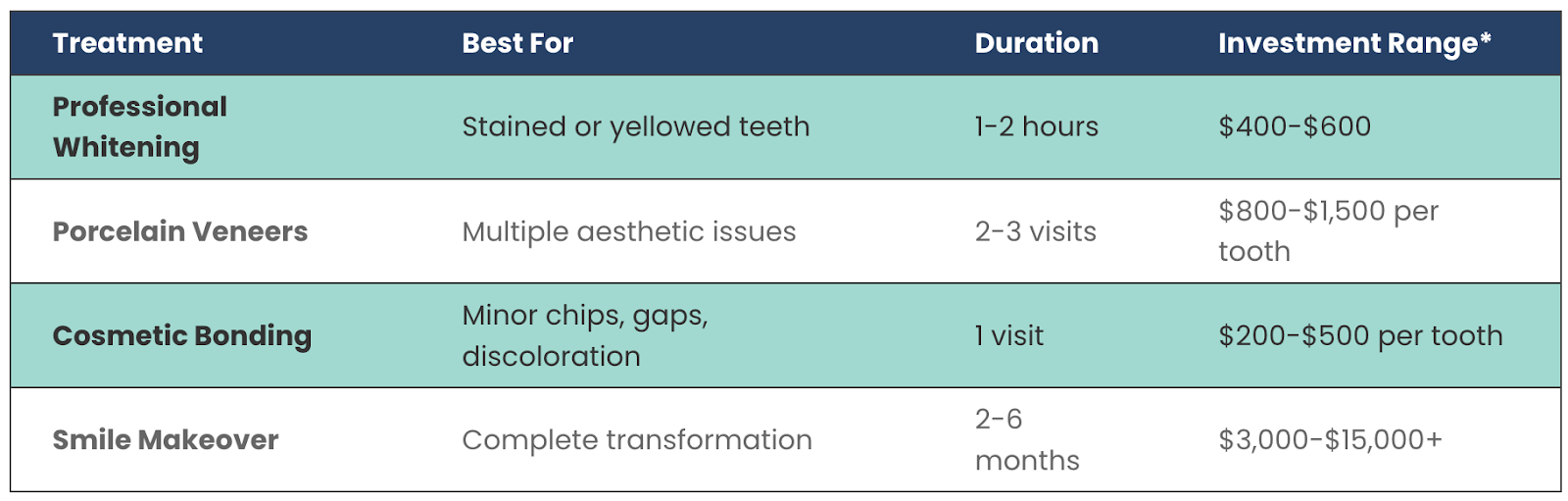
*Compliments of DeLand Family Dental’s Cosmetic Dentistry page.
Check out this content on the full run-down of the 21 Qualities of the Best Dental Websites
7. Improve Website Loading Speed
If your website takes too long to load, potential patients will leave before they even see what you have to offer. In the age of AI, site speed is even more critical. Fast-loading sites are easier for search engines and AI systems to crawl and process efficiently. Shoot for a Google PageSpeed Insights score of 90+ on mobile and desktop.
There are many reasons you want to do this, but speed is likely a ranking factor, and it’s essential to provide users with a good experience. Typically, a slow website isn't a good experience
8. Add Social Proof and Testimonials
A QR code is a special barcode you can put on your fliers and physical advertising material. When people scan the code on their phones, it will direct them to your website or another digital domain of your choice.
You can easily create one with a QR Code Generator, making it simple for people who see your marketing materials to find you online.
9. Use Clear Calls to Action (CTAs)
Every page on your website should guide the visitor toward the next step, whether that’s calling the office or filling out an appointment request form.
Agency Insight: Avoid generic "Contact Us" buttons. Use high-intent CTAs such as "Check Availability" or "Request Your Implant Consultation." If you offer online scheduling, ensure that "Book Online" is a floating button that remains visible as the patient scrolls.
10. Implement Interactive Lead Magnets for High-Value Cases
For high-production services like implants or full-mouth restorations, use value-first lead magnets. A simple quiz, such as "Are You a Candidate for Dental Implants?" or a downloadable "Patient Guide to Smile Makeovers," allows you to capture contact information early in the research phase, before a patient is ready to book.
Demand Generation and Advertising
While SEO and local discovery build long-term value, paid advertising lets you turn on the tap for specific high-volume procedures immediately.
Check out our dental marketing resource center. For help running campaigns, see our dental PPC agency services.
11. Facebook and Instagram Ads (Brand Discovery)
Facebook and Instagram are great platforms for building brand awareness and staying in front of potential patients. While social media users don’t have the same immediate search intent as Google users, the cost-per-click (CPC) on Meta platforms is typically much lower. This makes Facebook and Instagram an excellent, low-risk environment for testing patient-education videos and practice culture ads to see what resonates with your local demographic.
Agency Insight: Treat social media as a Discovery Channel. You should use it to introduce your practice to people before they have a dental emergency, building the familiarity that makes your Google Ads even more effective when they eventually do search for a dentist.
12. Google Ads (PPC) for High-Intent Demand
Google Ads are a powerful way to generate leads quickly by targeting patients who are actively searching for dental services. Be prepared for high competition; in 2026, high-intent keywords such as "dental implants" or "emergency dentist" can cost $20 to $50+ per click in competitive markets. Because you're paying for high-intent traffic, your landing pages should be ultra-specific to the ad to avoid wasting that investment.
13. Local Media Mentions and Search Lift
Getting featured in local news or community blogs can help build your practice's authority and reach. Local media mentions create search lift. When you're featured as an expert, patients search for your practice by name. These branded searches are the most valuable traffic you can get because the trust is already established before the click, and they signal to AI engines that you're a local authority.
14. Direct Mail with Digital Tracking
Direct mail is still an effective way to reach people in your local community, especially new movers. To make direct mail measurable in 2026, include QR codes that lead to dedicated landing pages. This allows you to track exactly which neighborhoods are responding, letting you adjust your mailing list based on real conversion data.
15. Community Giveaways
Hosting a giveaway is a great way to build your email list and increase local awareness. The real value of a giveaway isn't the prize; it's the lead list. Ensure you have an automated email follow-up for everyone who enters. An example would be to offer a new-patient welcome gift to turn those contest entries into actual appointments.
16. Launch an In-House Membership Plan
An in-house membership plan is a powerful strategy for attracting the 40%+ of patients who lack dental insurance. By highlighting predictable costs and loyalty benefits, you can build a recurring revenue stream and keep patients from shopping around every time they need a cleaning.
Content and Authority Building
17. Use Video to Humanize the Practice
Video is the most effective way to break down the anxiety barrier before a patient ever walks through your door. Create short "Meet the Doctor" and "Office Tour" videos to introduce your team. These not only make you more approachable but also increase time on page, a critical metric that signals to search engines that your content is valuable and engaging.
18. Build a Library of Patient Education (FAQ Strategy)
Don't just blog about general dental tips. Use your blog to answer the specific, high-intent questions you hear every day in your practice. Focus on a structured Q&A format; this is the primary source for AI Overviews. By providing the most direct, expert answer, you increase the chances of being the cited source at the top of Google’s search results.
19. Educational Email Newsletters
Email is one of the few channels you own. Use it to stay top-of-mind without paying for every click. Consistent email communication increases your patients' Lifetime Value (LTV) by reminding them of necessary hygiene visits or elective services they may have forgotten, effectively driving revenue from your existing database.
20. Leverage Case Studies and Before-and-After Galleries
For high-value cosmetic and restorative work, seeing is believing. Maintain an organized gallery of your work, but ensure you use descriptive alt-text for every image (e.g., "Full mouth dental implant restoration for [City] patient").
The Strategic Proof: In 2026, Alt text helps search engines understand what an image represents and reinforces the services your practice claims to provide. Google’s documentation confirms that image alt text helps search engines understand and index visual content accurately.
Note on Accessibility: Proper alt text also ensures your website is ADA-compliant. As dental practices are public accommodations, this is a legal necessity that also serves as a high-quality signal to search engines.
In 2026, content follows the quality over quantity rule. One deeply researched, expert-vetted article about a specific procedure is worth more than ten generic, AI-generated blog posts that offer no unique value.
21. Set Up Conversion Tracking (The Source of Truth)
In 2026, you can't rely on "How did you hear about us?" forms. Implement Dynamic Number Insertion (DNI) to track exactly which phone calls originated from Google Ads vs. Organic Search. This provides a clear source of truth for every lead, showing you exactly which marketing dollar resulted in a high-value procedure.
You may also want to read: A Review of the Best Lead Tracking for Dentists in 2026.
22. Monitor Patient Acquisition Cost (PAC)
Every practice should know its PAC. By calculating your Total Marketing Spend divided by Total New Patients, you can determine whether your growth is sustainable. In a healthy 2026 practice, our PAC should remain within 10% to 15% of the patient's first-year production value.
.jpg?width=54&name=Dental%20Marketing%20Scorecard%20(2026%20Edition).jpg)
It's generally accepted that the cost to acquire a new patient is around $150-$300.
When is it Okay to Go Over the Recommended CAC? Strictly adhering to a 10% CAC can sometimes stifle your growth. It's often acceptable, and even encouraged, to exceed these benchmarks in the following scenarios:
- The Launch Phase: New practices or new locations need to buy market share and build a patient base quickly to cover fixed overhead.
- High-Value Procedures: For high-ticket items such as dental implants or full-mouth reconstructions, the Lifetime Value (LTV) is so high that spending 20% or more on acquisition still yields a massive ROI.
- Low Market Share: If you have high clinical capacity but low visibility, spending more aggressively to fill your chairs is more profitable than letting a high-production operatory sit empty.
Agency Insight: Don't get distracted by vanity metrics, such as social media likes. In dentistry, only three numbers truly matter: Inbound Call Volume, Scheduled Appointments, and Case Acceptance Rate. If these aren't moving, your strategy needs an adjustment.
Retention, Referrals, and Internal Marketing
It's far more cost-effective to keep a patient than to acquire a new one. These strategies focus on the back end of your marketing funnel.
23. Automated Appointment Reminders and Reactivation
In 2026, ghosting is a major drain on production. Use automated SMS and email systems to handle reminders, but more importantly, use reactivation campaigns. Targeted messages to patients who haven’t been seen in 12+ months are the low-hanging fruit of dental marketing.
24. Patient Referral Programs
Word-of-mouth is still your most powerful lead source. Create a formal referral program that rewards existing patients for referring others. Whether it’s a gift card or credit toward professional whitening, make sure the thank-you is significant enough to be memorable.
25. In-Office Experience as Marketing
Marketing doesn't stop at the front door. Every touchpoint, from the scent of the lobby to the comfort of the blankets in the operatory, is a marketing signal. Patients who have a good experience are 5x more likely to leave a 5-star review, which directly feeds your AI visibility.
26. Video Testimonial Campaigns
While written reviews are great, video testimonials are the gold standard for high-ticket cases. A 30-second clip of a patient talking about their new smile carries more trust and authority with AI engines and humans than a thousand words of copy.
27. Birthday and Holiday Outreach
Simple, automated "Happy Birthday" messages or holiday greetings humanize your brand. In a world of clinical automated responses, personal touchpoints remind patients that real people are behind the screens. You can easily do this with most dental practice management software or patient engagement software.
28. Front Desk Training and Call Scoping
You can have the best marketing in the world, but if your front desk can't convert a caller into a scheduled appointment, your ROI will suffer. Regularly audit your calls to ensure your team answers questions with empathy and steers every conversation toward a firm appointment time.
29. Hyper-Local Content for Google Maps
In 2026, Google’s local algorithm prioritizes geographic relevance. Regularly post photos and updates to your Google Business Profile that feature your team at local community landmarks, sponsoring neighborhood events, or visiting nearby businesses. This signals to search engines that you're a deeply rooted neighborhood entity, which helps you outrank corporate chains that lack local ties.
As patients increasingly turn to AI-generated answers when researching providers, visibility can depend on more than local proximity signals alone. We explain the difference in our guide on why some dental practices rank in Google Maps but don’t appear in AI answers.
Conclusion: The 2026 Dental Blueprint
The landscape of dental marketing is shifting from mass advertising to precision trust. In 2026, the practices that win aren't necessarily the ones with the biggest budgets, but the ones with the best data and the highest entity authority.
When your practice publishes credible, high-authority content, strengthens its technical foundation for AI-driven search, carefully tracks conversions, and focuses on long-term patient value, you create a system that drives sustainable growth. That is what allows you to move forward during the 2026 shifts rather than react to them.
Success in this new era requires moving beyond ideas and into a structured system that you can measure, refine, and scale.

.png)
.png)
Tyson Downs is the founder of Titan Web Agency, a company specializing in marketing for dental professionals. With an impressive track record of working with over 100 dental practices, Tyson has a deep understanding of the unique marketing needs within the dental industry.
.svg)