---
title: "AI Visibility for Dentists: How to Show Up in AI Search (Dental GEO)"
description: Learn how dentists appear in AI search, ChatGPT, Gemini, and Google AI Overviews. See the dental GEO signals that make a practice easier to trust, cite, and recommend.
image: https://blog.titanwebagency.com/hubfs/Blog%20Covers%202026/geo-dental-visibility-cover-2026.jpg
---
[](https://titanwebagency.com/)
- About
[About Tyson DownsRead more about Tyson Downs](https://titanwebagency.com/about-us/tyson-downs/) [AboutRead more about the team at Titan Web Agency](https://titanwebagency.com/about-us/) [Our ReviewsWhat some of our clients have to say](https://titanwebagency.com/reviews/) [ResultsRead about results we've gotten for our clients](https://titanwebagency.com/results/) [Problems We SolveRead about some of the problems we can help you solve](https://titanwebagency.com/dental-marketing-problems/) [PortfolioCheck out our work](https://titanwebagency.com/portfolio/) [PodcastListen to our podcast](https://titanwebagency.com/podcast/)
Have questions?
Schedule a discovery call to discuss your practice goals.
Schedule Now
- [Blog](https://blog.titanwebagency.com/)
- Resources
Resources
[Dental Marketing GuideSix marketing channels to attract, convert, and retain more patients](https://titanwebagency.com/dental-marketing-guide/) [Running a Dental PracticeThe business disciplines that separate practices that grow from ones that plateau](https://titanwebagency.com/running-a-dental-practice/) [How to Get More Dental PatientsAttract, convert, and keep the patients your practice needs to grow](https://titanwebagency.com/attract-dental-patients/) [Dental Practice TransitionsEverything you need to know about buying, selling, relocating, or starting a practice](https://titanwebagency.com/dental-practice-transitions/)
Have questions?
Schedule a discovery call to discuss your practice goals.
Schedule Now
- Services
Services
[AI Search OptimizationHelp my practice appear in the AIO (AI Overviews), ChatGPT, Claude, Gemini, and more.](https://titanwebagency.com/services/ai-geo/) [Local SEOIncrease my local rankings in Google](https://titanwebagency.com/services/local-seo/) [Pay Per Click ManagementGet better results from Google, Bing, or Meta Ads.](https://titanwebagency.com/services/pay-per-click/) [Web DesignBuild me an awesome website](https://titanwebagency.com/services/web-design/) [Branding & RebrandingBranding or rebranding, we can handle it for you](https://titanwebagency.com/services/branding-rebranding/) [Logo DesignCreate a memorable & brand-able Logo](https://titanwebagency.com/services/logo-design/) [Review ManagementImprove my online reputation, help me get more positive reviews](https://titanwebagency.com/services/review-management/) [Website Hosting & MaintenanceHost, secure, & maintain my website](https://titanwebagency.com/services/website-maintenance/) [See all services →](https://titanwebagency.com/services/)
Have questions?
Schedule a discovery call to discuss your practice goals.
Schedule Now
[(801) 783-3101](tel:8017833101) [Get in touch](https://titanwebagency.com/contact/)
About
[About Tyson DownsRead more about Tyson Downs](https://titanwebagency.com/about-us/tyson-downs/) [AboutRead more about the team at Titan Web Agency](https://titanwebagency.com/about-us/) [Our ReviewsWhat some of our clients have to say](https://titanwebagency.com/reviews/) [ResultsRead about results we've gotten for our clients](https://titanwebagency.com/results/) [Problems We SolveRead about some of the problems we can help you solve](https://titanwebagency.com/dental-marketing-problems/) [PortfolioCheck out our work](https://titanwebagency.com/portfolio/) [PodcastListen to our podcast](https://titanwebagency.com/podcast/)
[Blog](https://blog.titanwebagency.com/)
Resources
[Dental Marketing GuideSix marketing channels to attract, convert, and retain more patients](https://titanwebagency.com/dental-marketing-guide/) [Running a Dental PracticeThe business disciplines that separate practices that grow from ones that plateau](https://titanwebagency.com/running-a-dental-practice/) [How to Get More Dental PatientsAttract, convert, and keep the patients your practice needs to grow](https://titanwebagency.com/attract-dental-patients/) [Dental Practice TransitionsEverything you need to know about buying, selling, relocating, or starting a practice](https://titanwebagency.com/dental-practice-transitions/)
Services
[AI Search OptimizationHelp my practice appear in the AIO (AI Overviews), ChatGPT, Claude, Gemini, and more.](https://titanwebagency.com/services/ai-geo/) [Local SEOIncrease my local rankings in Google](https://titanwebagency.com/services/local-seo/) [Pay Per Click ManagementGet better results from Google, Bing, or Meta Ads.](https://titanwebagency.com/services/pay-per-click/) [Web DesignBuild me an awesome website](https://titanwebagency.com/services/web-design/) [Branding & RebrandingBranding or rebranding, we can handle it for you](https://titanwebagency.com/services/branding-rebranding/) [Logo DesignCreate a memorable & brand-able Logo](https://titanwebagency.com/services/logo-design/) [Review ManagementImprove my online reputation, help me get more positive reviews](https://titanwebagency.com/services/review-management/) [Website Hosting & MaintenanceHost, secure, & maintain my website](https://titanwebagency.com/services/website-maintenance/) [See all services →](https://titanwebagency.com/services/)
Have questions?
Schedule a discovery call to discuss your practice goals.
[Schedule Now](https://titanwebagency.com/contact/)
[Call (801) 783-3101](tel:8017833101) [Get in touch](https://titanwebagency.com/contact/)
×
Updated October 18, 2026 by [Tyson Downs](https://blog.titanwebagency.com/author/tyson-downs) [Leave a Comment](https://blog.titanwebagency.com/geo-dental-visibility#comments-listing)
# How Dentists Improve Visibility in AI Search and Google AI Overviews
AI Visibility for Dentists: How to Show Up in AI Search (Dental GEO)
28:52
Have you noticed a shift in how patients search for dental care? Have you started searching differently over the past year or two? I know I have.
Table of Contents
[Why Dental Patient Search Behavior Is Changing](https://blog.titanwebagency.com/geo-dental-visibility#search-behavior) [What Is Generative Engine Optimization (GEO) and Why It Matters for Dental Visibility](https://blog.titanwebagency.com/geo-dental-visibility#generative-engine) [GEO vs SEO vs AI Search Optimization](https://blog.titanwebagency.com/geo-dental-visibility#geo-vs-seo) [What AI Can Verify About a Dental Practice](https://blog.titanwebagency.com/geo-dental-visibility#ai-can-verify) [What an AI Answer Cannot Safely Infer](https://blog.titanwebagency.com/geo-dental-visibility#cannot-infer) [Five Areas to Review When Your Practice Isn’t Appearing in AI Answers](https://blog.titanwebagency.com/geo-dental-visibility#five-signals) [How to Get Your Dental Practice Cited in ChatGPT](https://blog.titanwebagency.com/geo-dental-visibility#chatgpt) [How to Measure AI Visibility](https://blog.titanwebagency.com/geo-dental-visibility#measure) [What to Ask Your Marketing Company About AI Visibility](https://blog.titanwebagency.com/geo-dental-visibility#ask-your-agency) [What Changes When AI Search Visibility Starts Working](https://blog.titanwebagency.com/geo-dental-visibility#visibility-starts-working) [Case Study: The #1 AI-Visible Pediatric Dentist in Carlsbad](https://blog.titanwebagency.com/geo-dental-visibility#case-study) [Frequently Asked Questions](https://blog.titanwebagency.com/geo-dental-visibility#faq) [Final Thoughts](https://blog.titanwebagency.com/geo-dental-visibility#final-thoughts)
## Key Takeaways
- Patients are increasingly turning to AI-powered search to research dentists, compare practices, and ask recommendation-style questions before they ever contact an office.
- GEO, or generative engine optimization, helps AI systems better understand, trust, and potentially reference your dental practice when generating answers for patients.
- AI visibility depends on website clarity, consistent local SEO signals, strong reviews, and authoritative third-party mentions. No single tactic gets you there.
- Dentists should optimize for both traditional search and AI-assisted discovery. These systems build on each other rather than competing.
- The goal is to make it easier for AI systems and patients to trust.
- Some practices can make meaningful improvements internally. Others benefit from working with someone who specializes in this.
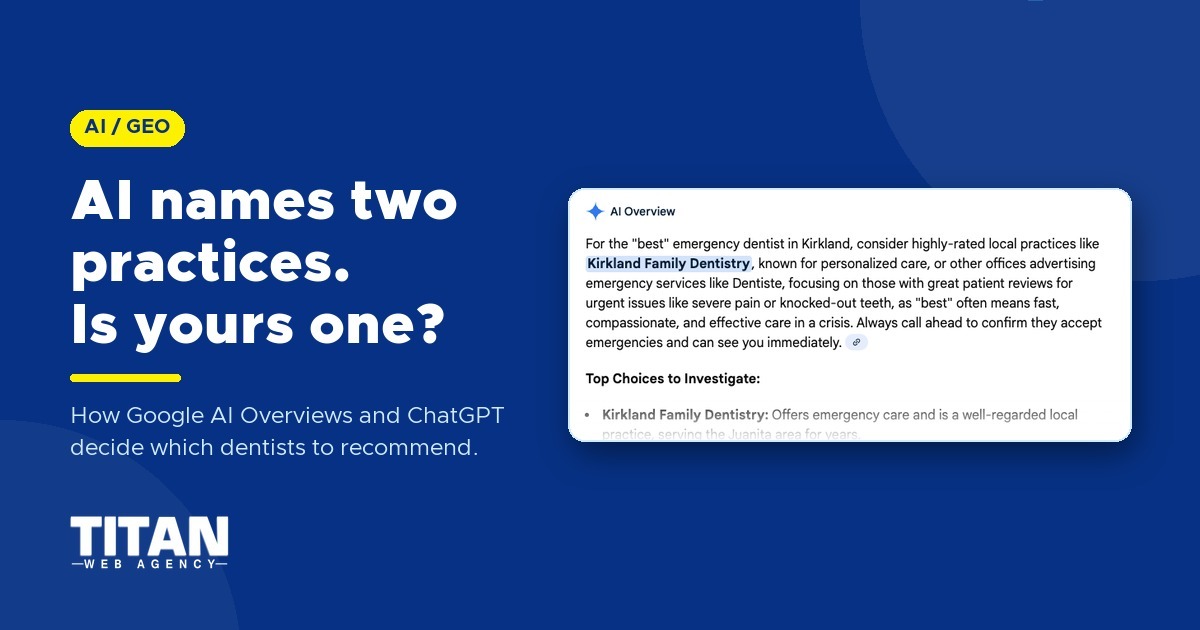
More people are turning to AI tools and voice assistants instead of typing full searches into Google. When a patient asks [ChatGPT](https://chatgpt.com/) or Google AI Overviews for a dentist recommendation, they get one or two names back, not a page of results. A recent AP-NORC poll found that about[60% of U.S. adults](https://www.ap.org/news-highlights/spotlights/2025/how-us-adults-are-using-ai-according-to-ap-norc-polling/) already use AI tools to search for information, and that number rises to 74% among adults under 30. This shift is already influencing how dental practices appear online, and staying visible now depends on understanding how these new systems deliver answers.
## How can a dental practice appear in AI search results?
A dental practice is more likely to appear in AI search results when its service pages clearly state what it treats, where it practices, and which patients it serves; its Google Business Profile and major listings match those facts; and credible third-party sources reinforce the same information. GEO is the work of making those signals clear enough for AI systems to verify and reuse.
### What to fix first
These five moves do the most for practice visibility in AI search, in roughly this order.
- **Service and location clarity.** Say plainly what you treat, who you treat, and where. Dental website GEO starts with pages a system can read without guessing.
- **Source-of-truth facts.** Name, address, phone, hours, providers, and services should match everywhere they appear.
- **Reviews and third-party corroboration.** Outside sources need to say the same thing your site says.
- **Patient-question content.** Answer the questions patients actually ask, in the words they use.
- **Measurement.** Track AI visibility for dentists with the same prompts, locations, and tools each time, so you can tell movement from noise.
/The%20AI%20Playbook%20for%20Dental%20Practices%20Cover.jpg?width=150&height=195&name=The%20AI%20Playbook%20for%20Dental%20Practices%20Cover.jpg)
What's Inside
### This post is the short version. Here's the playbook.
Everything above in order, plus the audit and the measurement rules. The full contents, before you give us an email.
1What changed: the four surfaces dental search now happens across
2The 15-point AI and local visibility audit, built to run quarterly
3Source of truth: the practice facts an answer engine has to verify
4Trust and reviews, including the privacy risk sitting in your responses
5Measurement: the right scoreboard for each surface
6 and 7Two dental case studies, with what they do and don't prove
8Guardrails: where AI helps, and where a person still has to verify
[Get the Free Playbook](https://info.titanwebagency.com/ai-playbook?utm_source=blog&utm_medium=inline_cta&utm_campaign=ai-playbook&utm_content=geo-dental-visibility-mid)
16 pages. One email, no phone call.
## Why Dental Patient Search Behavior Is Changing
Patient search behavior is changing fast, and this shift affects how your practice shows up online. More people rely on AI-powered tools to answer quick questions, compare options, and choose a provider. Understanding these changes helps you adjust your[dental marketing strategy](https://blog.titanwebagency.com/dental-marketing-ideas) so you stay visible wherever patients search.
### 1. From Keywords to Conversations
Patients once typed simple phrases such as “*best dentist near me”*. While they still do that, they're increasingly asking full questions, such as “*who is the best Invisalign dentist open late in \[city\]?”* Search tools are built to understand natural language, which means your content needs to reflect how people actually talk when they look for care.
### 2. AI Tools Are the New First Touchpoint
ChatGPT,[Google Gemini](https://gemini.google.com/),[Siri](https://www.apple.com/siri/), and[Alexa](https://alexa.amazon.com/) often provide answers before a patient ever sees a list of search results. These tools scan your dental website, reviews, and business listings to determine whether your practice matches what the patient is looking for. If your information is clear and trustworthy, you have a better chance of being included in those instant results.
### 3. Search Is Fragmenting Across Channels
Patients are no longer relying on a single search method. They look for dental care through voice searches, chat tools, mobile assistants, and AI-driven browsers. Each of these tools depends on structured content, accurate local information, and clear service descriptions. If your online presence is organized and consistent, these systems can place your practice in front of more potential patients.
### 4. Visibility Now Depends on AI Comprehension
Ranking well in traditional search results is still important, and we predict it won't ever stop being important. But there's more to it now. AI tools need to understand your practice. If your content is unclear, outdated, or inconsistent, these systems can't trust it. And if they can't trust it, they won't recommend your practice. Clarity, structure, and strong local signals now play a direct role in whether patients see you in their search results.
The gap between ranking on Google Maps and showing up in AI answers is growing fast. These[AI and GEO visibility strategies for dental practices](https://titanwebagency.com/services/ai-geo/) explain why and what to do about it.
**Agency Insight:** We've seen practices with strong local rankings get consistently skipped in AI-generated answers simply because their content wasn't written the way patients ask questions. Updating your service pages and FAQs to reflect natural, conversational language is one of the fastest ways to close that gap.
## What Is Generative Engine Optimization (GEO) and Why It Matters for Dental Visibility
GEO, or generative engine optimization, is the process of improving the signals that help AI-driven search tools understand, trust, and potentially reference your dental practice when they generate answers for patients.
Why does this matter now? Search no longer works the way it used to. AI systems are increasingly generating direct answers rather than showing long lists of websites. When a patient asks a question, AI systems summarize options and select which practices to surface rather than showing every result. That makes visibility more selective. If your practice doesn't fit cleanly into how AI understands the question, it may not appear at all, even if your traditional rankings are strong.
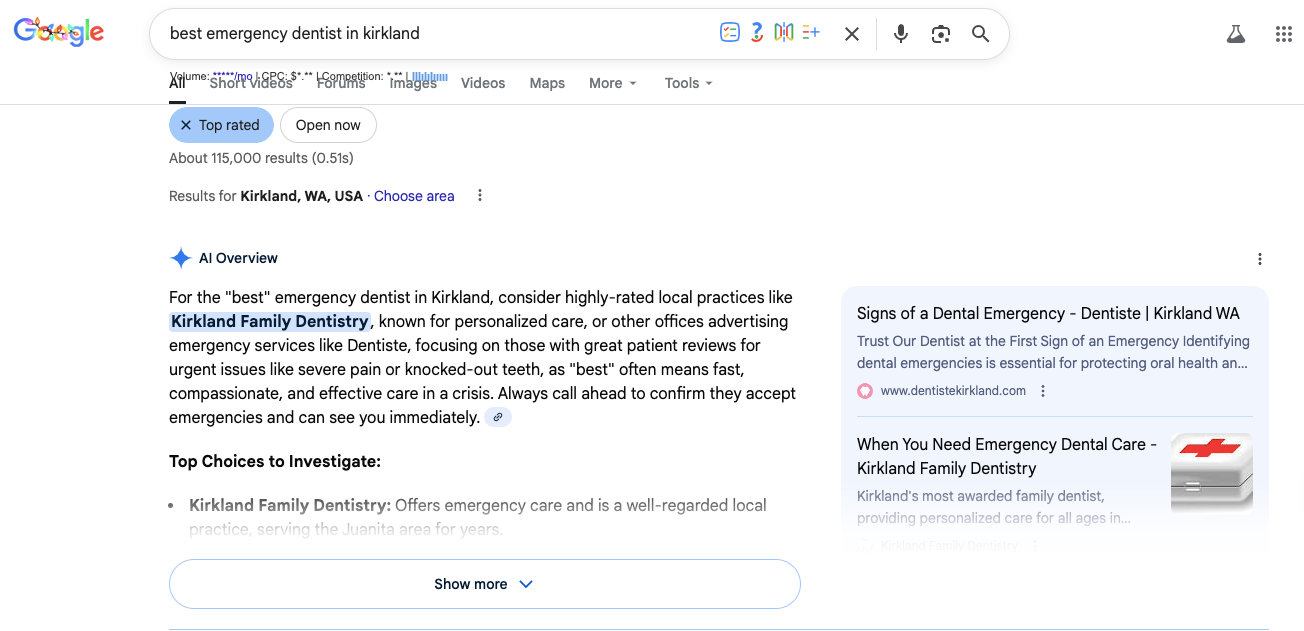
GEO helps close that gap. It strengthens how clearly your practice is defined across the web and how easily AI systems can connect your services, location, and credibility to patient questions. As AI-driven search becomes more common, GEO visibility is becoming just as important as your traditional local rankings.
The terminology varies across the industry. You may hear generative engine optimization, generative search optimization, or AI search visibility. The goal is the same regardless of what it's called: make your practice easier for AI to recognize as a reliable answer.
If you're looking for a done-for-you approach, [Titan Web Agency](https://titanwebagency.com/) offers[GEO services for dental practices](https://titanwebagency.com/services/ai-geo/).
## GEO vs SEO vs AI Search Optimization
SEO, GEO, and AI search optimization overlap. Companies use these terms differently, so ask what work is included rather than judging a proposal by its label.
SEO helps search engines find, understand, and rank your pages. GEO and AI search optimization generally describe work intended to improve how your business appears in AI-generated answers, including whether it’s mentioned or linked as a source.
Much of the work supports both: making pages accessible to search engines, explaining your services clearly, keeping practice information accurate, and publishing useful content patients can trust.
Google says its [existing SEO best practices apply to AI Overviews and AI Mode](https://developers.google.com/search/docs/appearance/ai-features). There are no additional technical requirements or special schema needed specifically for those features. That guidance applies to Google’s AI search features, not every AI platform.
For your practice, the useful question is what needs improvement and how you’ll measure it. A proposal should explain the work, the reasons for it, and how results will be reported.
## What AI Can Verify About a Dental Practice
AI systems don't follow a single ranking rule when they decide which practices to name. They look for information they can confirm from more than one place. When details are clear, consistent, and easy to reuse, a system is comfortable repeating them. When details are vague or conflicting, it usually skips the practice.
Here's what these systems can actually confirm about you:
- **What you treat and where.** "Emergency dentist in Kirkland offering same-day appointments" is verifiable. "Comprehensive dental care" is not.
- **Facts that match across sources.** Your site, your Google Business Profile, review platforms, and directories are cross-checked. If your website lists emergency care and your profile doesn't, that gap gets noticed.
- **Structure it can read.** Clear headings and focused service pages let a system pull the right detail for the right question. Dense pages that cover several topics at once make that harder.
- **Content shaped like an answer.** A plain explanation of what happens during an emergency visit can be summarized. A paragraph of marketing copy can't.
- **Signs of real patient activity.** Recent reviews and consistent listings suggest a practice that's active and legitimate.
- **Outside confirmation.** Mentions on directories, dental association pages, local news, and community resources build confidence that you are who you say you are.
## What an AI Answer Cannot Safely Infer
This is the part most practices miss. These systems are built to avoid stating things they can't support, so anything you leave implied usually gets dropped.
- **That you offer a service you never named.** If sedation or frenectomies aren't on the site in plain words, they don't exist as far as an AI answer is concerned.
- **Which cities you actually serve.** Being physically near a town isn't the same as saying you serve it.
- **That you're accepting new patients.** Unless you say so, it won't be assumed.
- **What you charge or which plans you take.** Vague insurance language produces vague answers, or none.
- **That your practice fits a specific patient.** "Great with anxious kids" has to be written and supported, not inferred from your photos.
When the connection between your information and the patient's question is weak, your practice may be left out even though you rank well for other terms. In those cases a system often gives a general answer and names nobody at all.
## Five Areas to Review When Your Practice Isn’t Appearing in AI Answers
If your practice isn’t appearing in AI answers, these are five areas worth checking. They’re a practical review framework, not a published ranking formula or a guarantee of inclusion.
1. **Clear services and locations.** Can someone quickly tell what you treat, where your office is, and which patients you serve? Give important treatments useful explanations instead of relying on a list of service names.
2. **Accurate practice information.** Check your business name, address, phone number, hours, and provider information across your website and important listings. Correct outdated or conflicting details.
3. **Information patients can use to evaluate you.** Make dentist credentials, office details, and genuine reviews easy to find. These help people decide whether your practice fits their needs.
4. **Relevant third-party references.** Review how professional directories, local organizations, and other credible websites describe your practice. Correct inaccurate information and pursue relevant opportunities to contribute your expertise.
5. **Answers to patient questions.** Explain the treatments, appointment options, and practical details people ask about. Write for the patient making a decision, with clear answers and enough detail to be useful.
Prioritize the gaps you actually find. Record what you change, then repeat your visibility checks to see whether the results differ.
## How to Get Your Dental Practice Cited in ChatGPT
When a patient asks ChatGPT for a dentist, it can search the web and build its answer from the sources it finds. You can’t control what ChatGPT says, but you can control the information it finds about your practice. The five areas above apply here too. These steps are specific to ChatGPT:
1. **Check what it says today.** Ask ChatGPT the questions your patients ask, like “best pediatric dentist near \[your city\],” and note which practices it names and which sources it links to. Ask the same questions again after you make changes.
2. **Make sure its search crawler can reach your website.** ChatGPT’s search uses OpenAI’s crawler, OAI-SearchBot. If your robots.txt file or firewall blocks it, your pages can’t be cited. Your web developer can check this in a few minutes.
3. **Make your pages easy to quote.** Each service page should answer the basics directly: what the treatment is, who it’s for, what the first visit looks like and how to book.
4. **Look at the sources it cites.** If ChatGPT keeps citing a directory or list where your practice is missing or out of date, correct your listing there.
There’s no single setting that makes ChatGPT recommend a dentist. Practices get cited when the sources it finds describe them clearly and consistently.
## How to Measure AI Visibility
Start by separating visibility from visits and inquiries. Your practice can appear in an AI answer without receiving a website visit, and a visit doesn’t necessarily become a patient inquiry.
Track these four things separately:
| What you’re measuring | What it means | What it tells you |
| --- | --- | --- |
| A mention | The answer names your practice. | Your practice appeared in that particular response. It doesn’t establish that someone visited your site or contacted you. |
| A linked citation | The answer includes a source link to a page on your website. | Your page was linked as a source. Check what the answer says and whether it recommends your practice or simply uses information from the page. |
| A referral visit | Your analytics identifies a visit from an AI platform. | Someone reached your website through a source your analytics could identify. Some visits won’t carry enough information for reliable attribution. |
| A qualified inquiry | A prospective client contacts your business and meets your qualification criteria. For a dental practice, that means a relevant prospective-patient inquiry. | You have a business opportunity. Attributing it to AI search requires supporting information, such as a recorded referral source or the person telling you how they found you. |
Make your checks repeatable. Use a consistent set of questions relevant to the practice. Record the exact wording, platform, model when available, date, location context, and whether web search was enabled. Save the response and its source links.
Look for patterns across repeated checks. AI answers can change between runs. A single mention, omission, or competitor recommendation doesn’t establish a trend.
Keep other marketing signals in context. Branded searches, Google Business Profile activity, and total inquiries can help you understand what’s happening across your marketing. An increase in those numbers doesn’t, by itself, show that AI visibility caused it.
For Google AI Overviews and AI Mode, [Google includes performance in Search Console’s Web search reporting](https://developers.google.com/search/docs/appearance/ai-features). Those totals alone don’t isolate traffic from its AI features.
## What to Ask Your Marketing Company About AI Visibility
If your marketing company reports that your AI visibility improved, ask them to show you what changed. These questions will help you understand the report:
- **Which questions did you test?** Ask for the exact prompts and why they matter to the patients you want to reach.
- **Where and when did you test them?** The report should identify the platforms, dates, and location context.
- **Was my practice mentioned, linked, or recommended?** Ask to see the responses and the pages cited.
- **Did you use the same testing method before and after?** Changes to the prompts or platforms can make the results difficult to compare.
- **What visits or inquiries could you connect to AI search?** Ask which results have supporting attribution and which remain unknown.
A useful report should make these distinctions clear. You should be able to see the evidence and understand its limits.
Want help reviewing your practice’s visibility? [Request an AI visibility audit](https://info.titanwebagency.com/ai-visibility-audit) from Titan Web Agency.
## What Changes for a Dental Practice When AI Search Visibility Starts Working
When GEO starts working, the change isn't about sudden traffic spikes or a flood of new phone calls overnight. It shows up in where your practice appears and how patients encounter it.
- Your practice starts appearing in a more selective set of AI-generated answers, including AI Overviews, conversational results, and voice responses. These systems are designed to surface only the practices they can confidently match to specific patient questions, so appearing here reflects stronger clarity and consistency across your online presence.
- Visibility shifts toward higher-intent moments, when patients are asking direct questions and looking for clear recommendations rather than browsing a list of options.
- AI systems develop a stronger and more accurate understanding of your practice, which means your information is more likely to be interpreted correctly and matched to the right patient questions over time.
- Your trust signals become more consistent and credible across the sources AI relies on, making it easier for those systems to treat your practice as a reliable option.
- Visibility aligns more closely with real patient intent, reducing the mismatch between what patients are searching for and what your practice actually offers.
None of this is instant, and AI visibility alone doesn't replace a full marketing strategy. What it does is put your practice in a stronger position as more patients start their search with AI tools rather than a traditional Google search.
**Agency Insight:** Don't expect your analytics to show a clear spike when GEO starts working. The shift is more gradual and shows up in places such as branded search growth, GBP insight improvements, and patients mentioning they "found you through a search." Manual testing inside AI tools is currently your best way to track it.
## Case Study: The #1 AI-Visible Pediatric Dentist in Carlsbad
**Challenge:** In a competitive Southern California market, the practice had strong reviews but was rarely included when parents asked AI who to see.
**What Titan Web Agency did:** Built parent-intent service and FAQ content, strengthened local signals and citations, and tracked AI visibility alongside local search performance.
**Verified result:** The practice reached a GEO score of 89/100 and #1 AI share of voice, became the most-cited pediatric dental website in its market, and increased Local Pack visibility from 33.7% to 55.6%. It generated 1,481 tracked patient leads across channels in a year.
Source: [Titan Web Agency results](https://titanwebagency.com/results/)
Two ways to start
Check your own AI visibility, or have us check it for you
Run the 15-point audit yourself, or ask us to score your practice against the competitors in your market.
[Use the 15-Point Audit](https://info.titanwebagency.com/ai-playbook?utm_source=blog&utm_medium=inline_cta&utm_campaign=ai-playbook&utm_content=geo-dental-visibility-diy) [Request an AI Visibility Audit](https://info.titanwebagency.com/ai-visibility-audit?utm_source=blog&utm_medium=inline_cta&utm_campaign=ai-visibility-audit&utm_content=geo-dental-visibility-dfy)
## Frequently Asked Questions
### What is dental GEO?
Dental GEO, or generative engine optimization, is the work of making a dental practice’s services, location, providers, and proof of trust clear enough for AI search systems to verify, cite, and reuse in patient answers. It builds on SEO, but its focus is whether an AI system can confidently understand and name the practice.
### How can a dental practice appear in AI search results?
A dental practice is more likely to appear in AI search results when its service pages clearly state what it treats, where it practices, and which patients it serves; its Google Business Profile and major listings match those facts; and credible third-party sources reinforce the same information. No single action guarantees inclusion, but these signals make the practice easier for AI systems to verify and reuse.
### Is dental GEO different from SEO?
Yes. SEO helps search engines discover and rank pages. Dental GEO builds on that foundation by making the practice’s facts, expertise, local relevance, and trust signals clear enough for AI systems to use when generating an answer. Strong SEO supports GEO, but ranking alone does not guarantee that a practice will be named in an AI answer.
### Does Google Business Profile affect AI visibility?
It can. A complete, accurate Google Business Profile gives patients and search systems a consistent source for a practice’s name, address, phone number, hours, services, reviews, and location. Keep those details consistent with the practice website and other major listings.
### Can reviews influence AI search visibility?
Reviews can reinforce that a practice is active, credible, and relevant to the patient needs it serves. Recent, specific reviews are most useful when they align with the services, location, and patient experience described on the practice website. Reviews are one trust signal, not a guarantee of inclusion in every AI answer.
### How long does dental GEO take to work?
There is no universal timeline. A practice may see early changes after it improves the clarity and consistency of its information, but meaningful progress depends on the strength of its local SEO foundation, market competition, website content, and third-party proof. Measure visibility over time with the same prompts, location settings, and AI platforms.
### Should dentists hire an agency for GEO?
Some practices can improve dental GEO internally if they have a strong local SEO foundation and time to maintain accurate practice information, patient-focused content, and measurement. Practices with multiple locations, competitive markets, or limited internal capacity may benefit from specialized help.
### How do I get my dental practice recommended by ChatGPT?
Make sure ChatGPT’s search crawler, OAI-SearchBot, can reach your website. Then make your service pages answer patient questions clearly, keep your business details consistent everywhere, and correct outdated listings on the sites ChatGPT cites. No single setting guarantees a recommendation.
## Final thoughts
AI now plays a real role in how patients find dental care, and that's not changing. The practices that stay visible as this shift continues aren't doing something completely different from traditional SEO. They're doing the same foundational work, clear services, consistent information, strong reviews, and making sure AI systems can actually understand and trust what they find.
This isn't about chasing a new set of tactics or reacting every time a new AI tool launches. It's about building a presence that's easy for both patients and AI to trust, so your practice shows up when it matters most.
At Titan Web Agency, that's exactly how we approach this work. If you want a strategy that supports long-term visibility as AI continues to reshape how patients search, we'd love to help you take the next step.
Free strategy call
Want your dental practice to show up in AI-powered search results?
Learn how to structure your website and local signals so AI tools can understand your practice, improve your visibility in AI-powered search, and help you attract more of the right patients consistently.
[Book a Free 15-Min Strategy Call](https://info.titanwebagency.com/appt?utm_source=blog&utm_medium=inline_cta&utm_campaign=appt&utm_term=card-dark&utm_content=geo-dental-visibility-end)
No pitch. No pressure. Clear next steps.
- [Tyson Downs](https://blog.titanwebagency.com/author/tyson-downs)
- [AI/GEO](https://blog.titanwebagency.com/topic/ai-geo)
Tyson Downs Founder, Titan Web Agency
[](https://www.facebook.com/titanwebagency) [.png)](https://twitter.com/TitanWebAgency) [.png)](http://www.linkedin.com/in/tysondowns)
Tyson Downs is the founder of Titan Web Agency, a company specializing in marketing for dental professionals. With an impressive track record of working with over 100 dental practices, Tyson has a deep understanding of the unique marketing needs within the dental industry.
## Related Posts
[Browse all posts](https://blog.titanwebagency.com/)
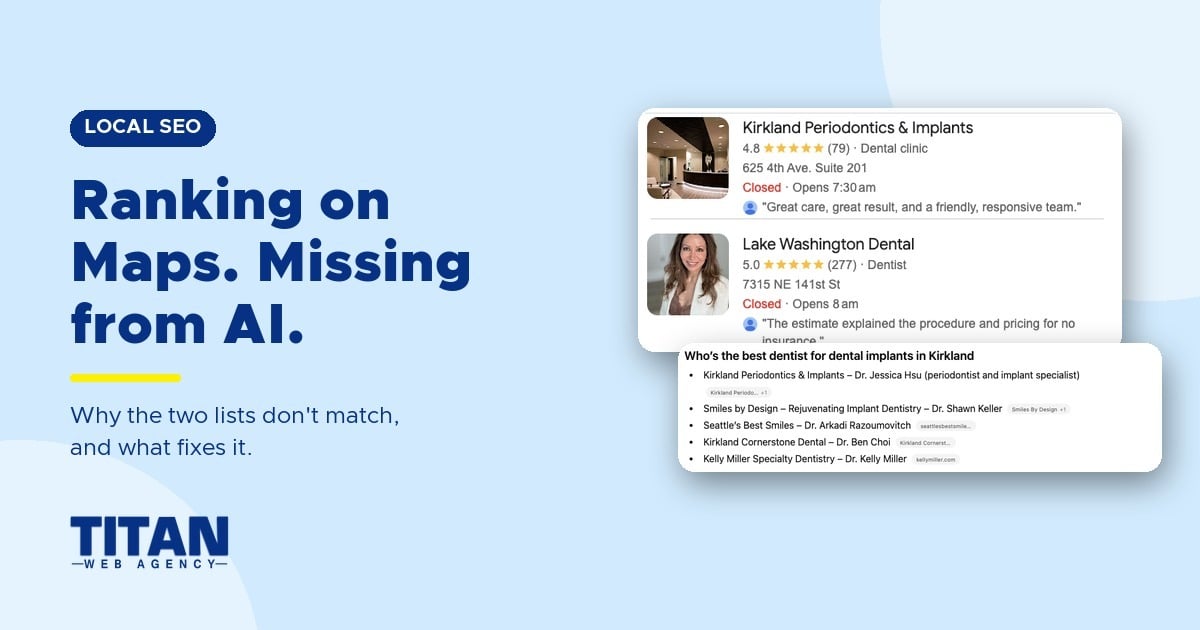
### Why Your Dental Practice Appears in Local Search Results but Not in AI Answers
When patients search for a dentist today, the process often...
Updated September 26, 2026
[Read More .svg)](https://blog.titanwebagency.com/google-maps-vs-ai-search)
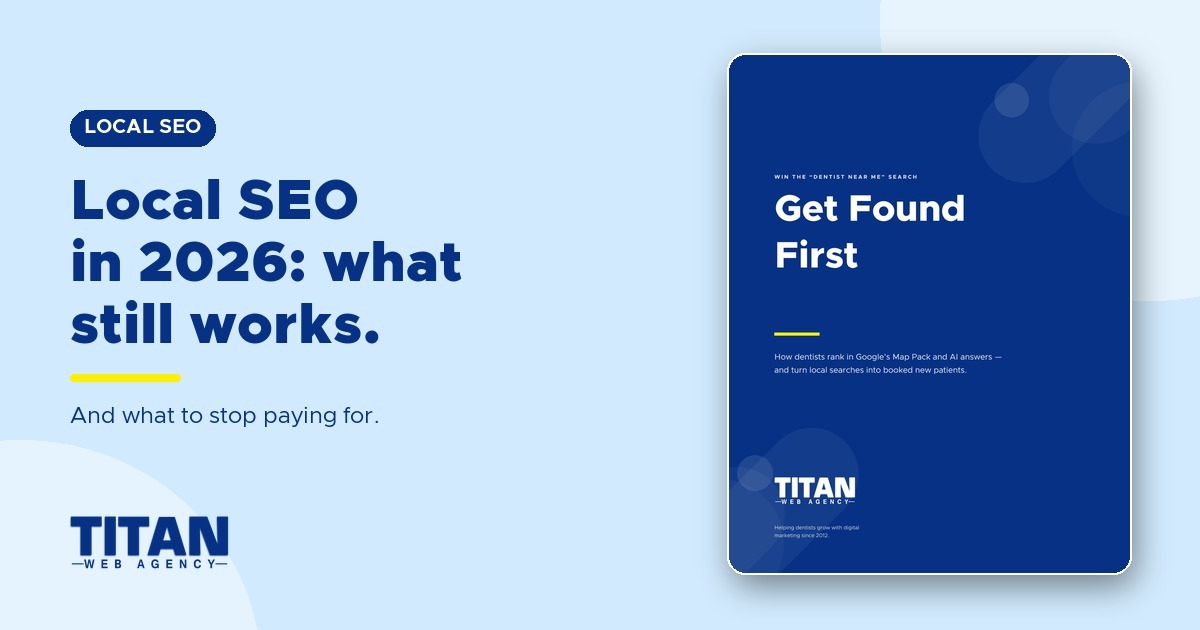
### A Local SEO Guide for Dentists: What Works in 2026 and What Doesn’t
Local SEO for dentists has changed significantly in 2026, and...
Updated September 26, 2026
[Read More .svg)](https://blog.titanwebagency.com/local-seo-guide-for-dentists)
[](https://titanwebagency.com/)
[Results](https://titanwebagency.com/results/)
[Reviews](https://titanwebagency.com/reviews/)
[Portfolio](https://titanwebagency.com/portfolio/)
[](https://www.google.com/partners/agency?id=6710457398)
SERVICES
- [Local SEO](https://titanwebagency.com/services/local-seo/)
- [AI Search Optimization](https://titanwebagency.com/services/ai-geo/)
- [Pay Per Click Management](https://titanwebagency.com/services/pay-per-click/)
- [Web Design](https://titanwebagency.com/services/web-design/)
- [Logo Design](https://titanwebagency.com/services/logo-design/)
- [Website Hosting & Maintenance](https://titanwebagency.com/services/website-maintenance/)
- [Review Management](https://titanwebagency.com/services/review-management/)
- [Branding & Rebranding](https://titanwebagency.com/services/branding-rebranding/)
RESOURCES
- [Dental Marketing Guide](https://titanwebagency.com/dental-marketing-guide/)
- [How to Get More Dental Patients](https://titanwebagency.com/attract-dental-patients/)
- [Running a Dental Practice](https://titanwebagency.com/running-a-dental-practice/)
- [Dental Practice Transitions](https://titanwebagency.com/dental-practice-transitions/)
- [Blog](https://blog.titanwebagency.com/)
- [Podcast](https://titanwebagency.com/podcast/)
GET IN TOUCH
[Call (801) 783-3101→](tel:8017833101) Schedule a call→ [Contact form→](https://titanwebagency.com/contact/)
[](https://www.facebook.com/TitanWebAgency) [](https://twitter.com/TitanWebAgency) [](https://instagram.com/titanwebagency/) [](https://www.linkedin.com/company/titan-web-agency) [](https://www.youtube.com/user/TitanWebAgency)
Copyright © 2026 [Titan Web Agency.](https://titanwebagency.com/) All rights reserved.
[Privacy Policy](https://titanwebagency.com/privacy-policy/)[Cookie Policy](https://titanwebagency.com/cookie-policy/)[Contact](https://titanwebagency.com/contact/)[Utah Dental Web Design](https://titanwebagency.com/utah-dental-web-design-company/)[Utah Dental SEO](https://titanwebagency.com/utah-dental-seo-company/)[Utah Dental Marketing](https://titanwebagency.com/utah-dental-marketing-agency/)


[ Call](tel:(801)%20783-3101) [ Schedule](https://app.lunacal.ai/titanwebagency/meeting/embed?embed=meeting&layout=&embedType=inline&duration=15) [ Contact Us](https://titanwebagency.com/contact/)
```json
{
"@context" : "https://schema.org",
"@id" : "https://blog.titanwebagency.com/geo-dental-visibility/#article",
"@type" : "BlogPosting",
"associatedMedia" : {
"@type" : "AudioObject",
"name" : "Dental GEO: How to Improve Your Practice Visibility in AI Search",
"url" : "https://blog.titanwebagency.com/hubfs/AI-Generated%20Media/Post%20Narration%20Audio/202005239710-TTS-1780221003472.mp3"
},
"author" : {
"@type" : "Person",
"name" : "Tyson Downs",
"sameAs" : [ "https://www.linkedin.com/in/tysondowns/" ],
"url" : "https://blog.titanwebagency.com/author/tyson-downs"
},
"dateModified" : "2026-10-18T12:59:44-06:00",
"datePublished" : "2025-12-10T09:00:00-07:00",
"description" : "Learn how dentists appear in AI search, ChatGPT, Gemini, and Google AI Overviews. See the dental GEO signals that make a practice easier to trust, cite, and recommend.",
"headline" : "Dental GEO: How Dentists Improve Visibility in AI Search and Google AI Overviews",
"image" : {
"@type" : "ImageObject",
"height" : 620,
"url" : "https://blog.titanwebagency.com/hubfs/How%20GEO%20Improves%20Dental%20Visibility%20in%20AI%20Results%20A%202026%20Guide%20for%20Dentists2.jpg",
"width" : 1200
},
"inLanguage" : "en-US",
"isPartOf" : {
"@id" : "https://blog.titanwebagency.com/#blog",
"@type" : "Blog",
"name" : "Titan Web Agency Blog",
"url" : "https://blog.titanwebagency.com/"
},
"mainEntityOfPage" : {
"@id" : "https://blog.titanwebagency.com/geo-dental-visibility/",
"@type" : "WebPage"
},
"publisher" : {
"@type" : "Organization",
"logo" : {
"@type" : "ImageObject",
"height" : 180,
"url" : "https://titanwebagency.com/wp-content/uploads/2025/01/LOGO3-New-Blue-No-Tagline-Titan-Blue-Logo-1-1.png",
"width" : 453
},
"name" : "Titan Web Agency",
"url" : "https://titanwebagency.com/"
},
"url" : "https://blog.titanwebagency.com/geo-dental-visibility/"
}
```
```json
{
"@context" : "https://schema.org",
"@id" : "https://blog.titanwebagency.com/geo-dental-visibility/#faq",
"@type" : "FAQPage",
"inLanguage" : "en-US",
"mainEntity" : [ {
"@type" : "Question",
"acceptedAnswer" : {
"@type" : "Answer",
"text" : "Dental GEO, or generative engine optimization, is the work of making a dental practice’s services, location, providers, and proof of trust clear enough for AI search systems to verify, cite, and reuse in patient answers. It builds on SEO, but its focus is whether an AI system can confidently understand and name the practice."
},
"name" : "What is dental GEO?"
}, {
"@type" : "Question",
"acceptedAnswer" : {
"@type" : "Answer",
"text" : "A dental practice is more likely to appear in AI search results when its service pages clearly state what it treats, where it practices, and which patients it serves; its Google Business Profile and major listings match those facts; and credible third-party sources reinforce the same information. No single action guarantees inclusion, but these signals make the practice easier for AI systems to verify and reuse."
},
"name" : "How can a dental practice appear in AI search results?"
}, {
"@type" : "Question",
"acceptedAnswer" : {
"@type" : "Answer",
"text" : "Yes. SEO helps search engines discover and rank pages. Dental GEO builds on that foundation by making the practice’s facts, expertise, local relevance, and trust signals clear enough for AI systems to use when generating an answer. Strong SEO supports GEO, but ranking alone does not guarantee that a practice will be named in an AI answer."
},
"name" : "Is dental GEO different from SEO?"
}, {
"@type" : "Question",
"acceptedAnswer" : {
"@type" : "Answer",
"text" : "It can. A complete, accurate Google Business Profile gives patients and search systems a consistent source for a practice’s name, address, phone number, hours, services, reviews, and location. Keep those details consistent with the practice website and other major listings."
},
"name" : "Does Google Business Profile affect AI visibility?"
}, {
"@type" : "Question",
"acceptedAnswer" : {
"@type" : "Answer",
"text" : "Reviews can reinforce that a practice is active, credible, and relevant to the patient needs it serves. Recent, specific reviews are most useful when they align with the services, location, and patient experience described on the practice website. Reviews are one trust signal, not a guarantee of inclusion in every AI answer."
},
"name" : "Can reviews influence AI search visibility?"
}, {
"@type" : "Question",
"acceptedAnswer" : {
"@type" : "Answer",
"text" : "There is no universal timeline. A practice may see early changes after it improves the clarity and consistency of its information, but meaningful progress depends on the strength of its local SEO foundation, market competition, website content, and third-party proof. Measure visibility over time with the same prompts, location settings, and AI platforms."
},
"name" : "How long does dental GEO take to work?"
}, {
"@type" : "Question",
"acceptedAnswer" : {
"@type" : "Answer",
"text" : "Some practices can improve dental GEO internally if they have a strong local SEO foundation and time to maintain accurate practice information, patient-focused content, and measurement. Practices with multiple locations, competitive markets, or limited internal capacity may benefit from specialized help."
},
"name" : "Should dentists hire an agency for GEO?"
}, {
"@type" : "Question",
"acceptedAnswer" : {
"@type" : "Answer",
"text" : "Make sure ChatGPT’s search crawler, OAI-SearchBot, can reach your website. Then make your service pages answer patient questions clearly, keep your business details consistent everywhere, and correct outdated listings on the sites ChatGPT cites. No single setting guarantees a recommendation."
},
"name" : "How do I get my dental practice recommended by ChatGPT?"
} ],
"url" : "https://blog.titanwebagency.com/geo-dental-visibility/#faq"
}
```