When patients search for a dentist today, the process often begins with a question. As AI search becomes part of everyday browsing, patients increasingly begin by asking a question and reviewing the AI-generated answer, such as from ChatGPT or Google AI Overviews.
That shift changes how visibility works. A national survey from the Associated Press–NORC Center for Public Affairs Research found that about 60% of U.S. adults already use AI tools to search for information.
You might rank in the top three on Google Maps.
You might have strong reviews, a solid local authority, and steady traffic.
Yet when someone asks ChatGPT, Gemini, or another AI assistant for the “best dentist near me,” your competitor gets mentioned, and you don’t.
That disconnect creates a real concern. If you’re investing in local SEO, why isn’t it translating into AI visibility?
One question we hear often is:
/The%20AI%20Playbook%20for%20Dental%20Practices%20Cover.jpg?width=190&name=The%20AI%20Playbook%20for%20Dental%20Practices%20Cover.jpg)
Why does my dental practice appear in local search results but not in AI answers?
AI systems generate responses by interpreting information from across the web. When a practice’s expertise, services, and reputation are clearly supported by consistent information, it becomes easier for those systems to reference that practice when answering patient questions.
In this guide, you’ll learn why some practices are mentioned in AI answers while others aren’t, and how to recognize when a visibility gap may exist.
Imaging is one of the higher-stakes tech decisions a practice makes. These dental practice software resources help you evaluate your options with confidence.
The gap between ranking on Google Maps and showing up in AI answers is growing fast. Here's what getting your practice found in AI-generated answers actually requires.

How AI Systems Decide Which Dentists to Mention
When someone asks an AI assistant about dental care, the system gathers information from multiple sources across the web and looks for signals that indicate credibility and expertise.
Rather than simply listing nearby businesses, the system references practices whose information clearly supports the answer it is generating.
Several signals commonly influence whether a dental practice is mentioned.
- Entity authority: AI systems identify practices that are consistently present across trusted websites (or so they say; we've seen spammy and self-promotional "top 10 lists" being cited by LLM's). Mentions in directories, professional profiles, and reputable sources reinforce that a practice is established and legitimate.
- Content clarity: Websites that clearly explain services, specialties, and patient needs are easier for AI systems to interpret and reference.
- Topical depth: Practices that publish detailed explanations about treatments, procedures, and patient questions demonstrate subject expertise.
- Trust signals: The quality, quantity, and consistency of patient reviews, along with professional affiliations, citations, and accurate business information across platforms, add to the overall credibility. Maintaining strong feedback across platforms often requires consistent review management for dental practices.
When these signals align, AI systems are more likely to recognize a practice as a reliable source of information.
Why Your Practice May Not Appear in AI Answers
Even when a dental practice ranks well in local search thanks to strong local SEO for dentists, many factors may influence how often it appears in AI-generated answers.
Generative search systems tend to reference sources that demonstrate clear topical coverage, depth, and consistency across the web. When those signals are weak or incomplete, a practice may be less likely to be cited when an AI system generates a response.
Some common contributors include:
- Limited topical depth: If your website briefly mentions treatments without explaining them in detail, AI systems may not consider your site a strong informational source on those topics.
- Weak entity clarity across the web: Consistent mentions across your website, directories, and professional profiles help search and AI systems recognize and reconcile your practice as a clear digital entity. Inconsistent information can make that recognition harder.
- Unclear service positioning: Practices that clearly explain their specialties, services, and patient focus provide a stronger context for AI systems to interpret when generating answers.
- Thin service pages: Short or generic service pages usually lack the detail systems need to confidently reference the practice when responding to patient questions.
- Fragmented information across platforms: When services, credentials, or descriptions vary across listings, directories, and the website, it becomes harder for systems to build a consistent understanding of the practice.
- Technical and authority signals: Factors such as crawlability, structured data, high-quality references, reputable backlinks, and strong review signals may also affect whether a site is considered a reliable source.
Providers typically don’t share the full details of their inclusion criteria for AI-generated answers, and each AI system may prioritize different signals. When it comes to health topics, many systems also depend significantly on trusted medical or educational sources, which may affect how often specific practices are referenced.
These factors don’t necessarily affect local rankings in the same way. However, they can influence how frequently a practice appears in AI-generated summaries.
How to Tell If You Have a Visibility Gap
You don’t need advanced tools to sense when something is off. In most cases, the signals are visible.
Start with simple observation.
Search for your core services the way a patient would. Try both types of behavior:
- A direct local search, such as “dentist near me” or “cosmetic dentist in [your city]”
- A question-based search, such as “Who’s the best dentist for dental implants?” or “What’s the best option for replacing missing teeth?”
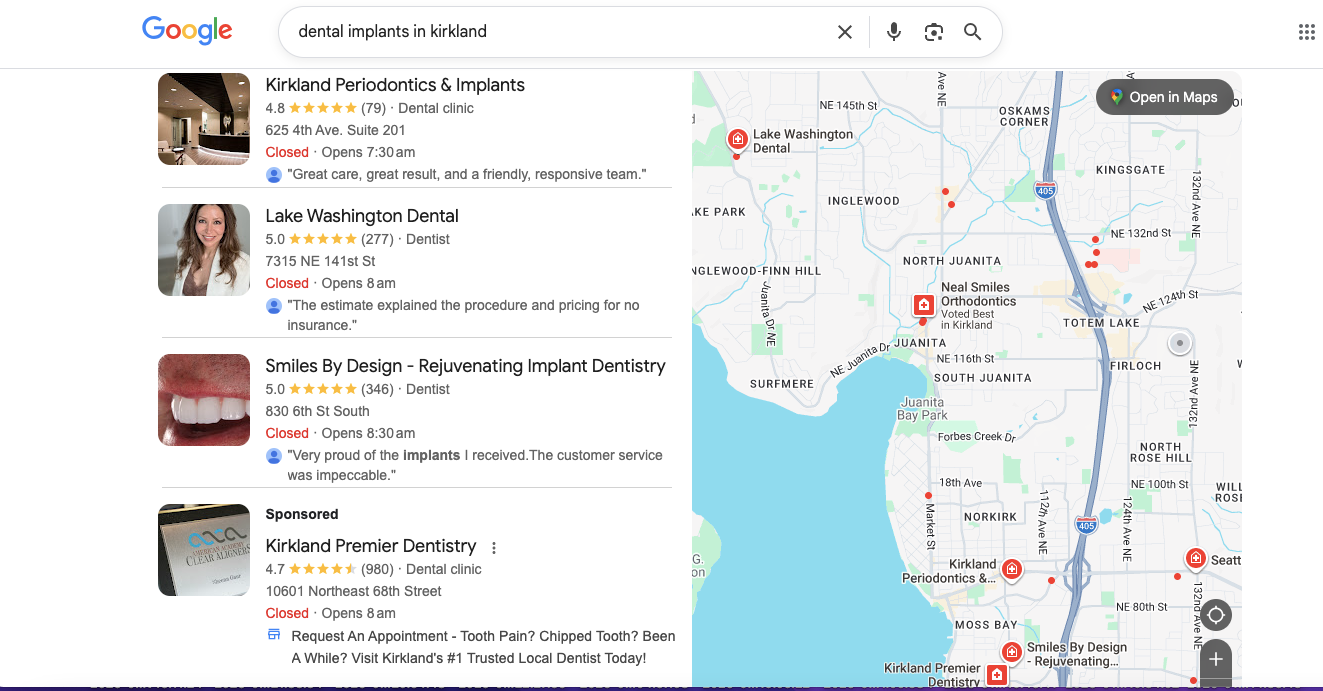
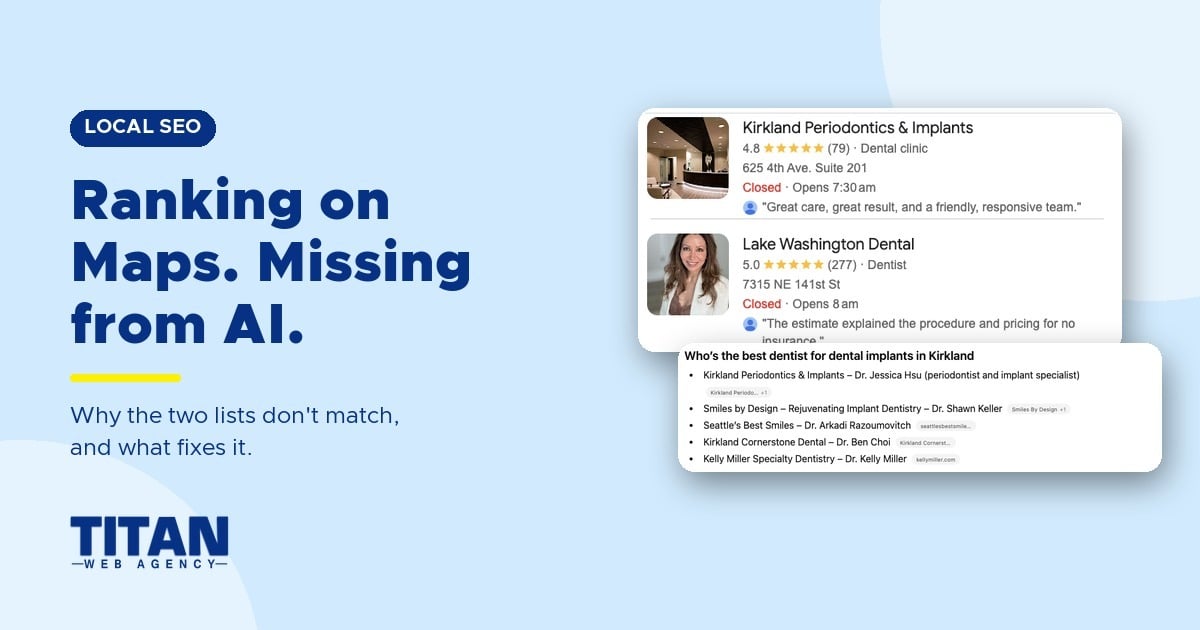
The image above shows the local map results for the search “dental implants in Kirkland.”

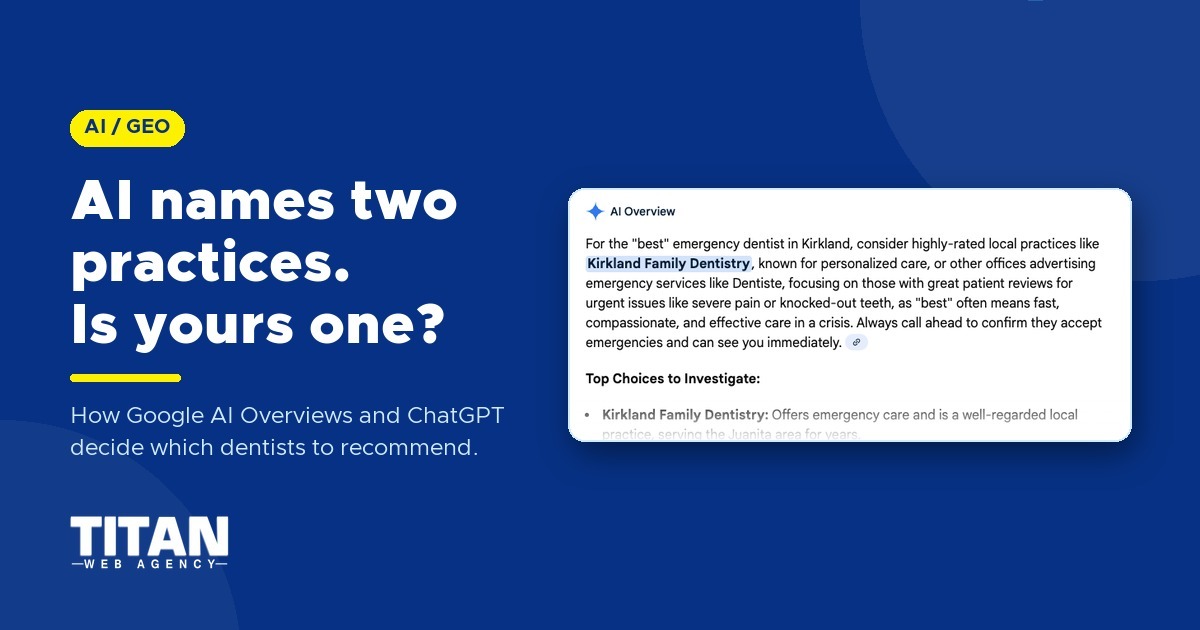
The image above shows the AI-generated answer for the query “Who’s the best dentist for dental implants in Kirkland?”
Now compare what happens.
Do you consistently appear in the Local Pack but rarely get mentioned in AI-generated summaries?
Does a competitor show up in AI answers even though you outrank them on Maps?
Do AI tools describe services you offer, but never associate them clearly with your practice?
Those patterns point to a visibility gap.
Another signal is inconsistency across platforms. If your services are described differently across your website, business listings, and third-party directories, AI systems may struggle to form a clear understanding of your practice as a digital entity.
You might also notice that your reviews are strong, but your service pages offer only brief, generic explanations of the treatments you offer. While reviews and profile signals help increase local visibility, limited on-site content can make it harder for AI systems to accurately understand your expertise and reference your practice in their answers.
The key isn’t whether you rank somewhere. It’s whether your visibility is aligned across search environments.
Frequently Asked Questions About AI Search and Local SEO
Does AI search replace local search results?
No. Local listings and AI answers serve different purposes. Local search helps users compare nearby providers, while AI-generated summaries help users understand their options.
Can a new dental practice appear in AI answers?
Yes, in some cases. AI tools may reference practices that publish strong informational content, even if their local ranking signals are still developing.
Do AI answers change frequently?
Yes. AI responses are generated dynamically based on the wording and the context of a question, so the results can change depending on how the query is asked.
Do online reviews influence AI visibility?
Reviews contribute to credibility signals that AI systems may interpret when evaluating whether a practice appears trustworthy.
Will improving AI visibility hurt local SEO?
No. Clear service pages, strong authority signals, and consistent information across the web usually strengthen both types of visibility.
How long does it take to improve AI visibility?
Timelines vary. Visibility tends to improve gradually as your practice builds stronger expertise signals and consistent information across platforms.
Improving Visibility Across Modern Search
If your dental practice ranks well in local search results but rarely appears in AI-generated answers, the issue usually isn’t that your SEO strategy has failed.
More often than not, your practice is visible in one search environment but less so in another.
Patients now discover dentists through several paths. They browse local listings, explore search results, and increasingly ask AI assistants for recommendations.
When your services, expertise, and reputation are clearly represented across the web, your practice becomes easier for both search engines and AI systems to recognize and reference.
At Titan Web Agency, we help dental practices strengthen their visibility through Local SEO and AI search optimization. We help them improve how they appear in local search and how AI systems recognize and feature their practice in AI-generated results.
Be sure to check out some of our results.
If your practice ranks locally but rarely appears in AI-generated answers, a visibility audit can help identify where the gap lies and which signals need strengthening.
Free strategy call
Ranking in local results but not appearing in AI answers?
We'll review your website content, Google Business Profile, local listings, and authority signals to identify why your practice ranks locally but isn't appearing in AI-generated answers. You'll also see how strengthening these signals can improve both local visibility and AI search recognition.
Book a Free 15-Min Strategy CallNo pitch. No pressure. Clear next steps.

.png)
.png)
Tyson Downs is the founder of Titan Web Agency, a company specializing in marketing for dental professionals. With an impressive track record of working with over 100 dental practices, Tyson has a deep understanding of the unique marketing needs within the dental industry.
.svg)