
Every dental SEO proposal promises the same things. More patients. Page one. A plan built just for your practice.
Then you put three proposals side by side and they read almost word for word alike.
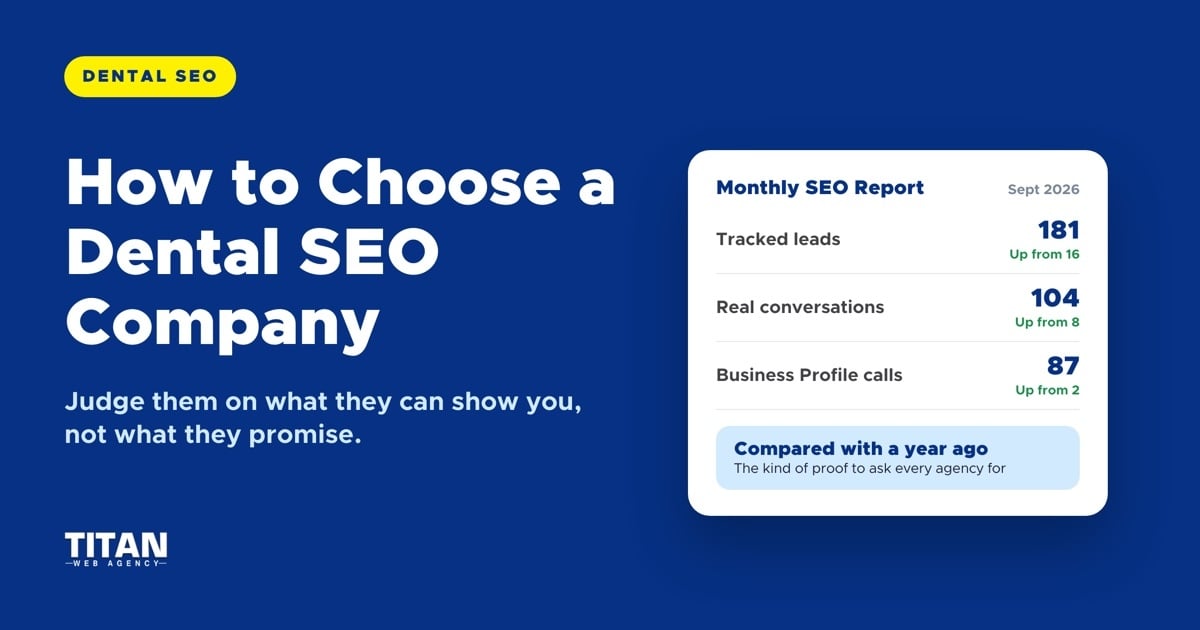
That's the real problem with figuring out how to choose a dental SEO company: on paper, they all sound the same. So stop judging them on what they promise. Judge them on what they can show you, and on what you can check yourself. A good dental SEO company makes that easy.
I've spent 15 years in digital marketing and worked with over 100 dental practices, and I've seen these proposals from both sides.
This guide covers the questions to ask before you sign, four checks you can run on any agency's proof, the red flags that should end the conversation, and a 30-minute scorecard you can use with your finalists (or with the agency you already have).
The short version: what a good dental SEO company can show you
A good dental SEO company should be able to show you all of this:
- Your practice owns its website, Google Business Profile, Google Analytics, Google Ads, Google Tag Manager and Search Console, and you have admin access to all of them.
- They can explain what they'd fix first in your market, and why.
- Their reports separate real conversations from spam and short calls, and count first-time callers on their own.
- They can show dental results with the starting point, the timeframe and the work behind them.
- Their dental clients show up in Google Maps when you search from those clients' towns.
- They don't guarantee rankings or patient numbers, and the contract lets you leave without a fight.
If they can't show you these, the rest of the proposal doesn't matter much.
Why dental SEO is a local problem first
Most new patients don't find a dentist by scrolling through ten blue links. They see the map results at the top of Google, tap a Business Profile, read a few reviews and call. Your website matters, but a lot of the decision happens before anyone gets there.
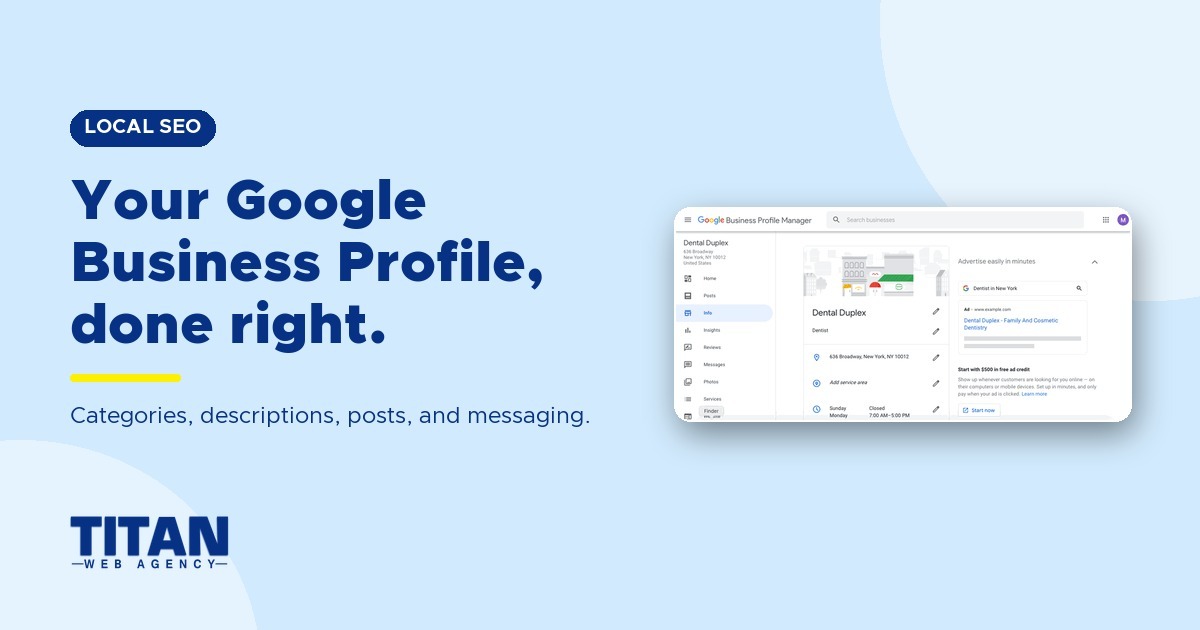
For a lot of practices, the Google Business Profile matters more than the website. It's common for more new patients to come through the Google listing than through the site itself, so agencies that put all their effort into the website are working on the wrong thing first.
That's what makes dental SEO different from SEO for an online store. It's local, and local results change block by block. A practice can rank first for "dentist near me" at its own front desk and fifth two miles away, where most of its patients actually live.
Keep that in mind for the rest of this guide. When an agency shows you a ranking, the first question is where it was checked from. For more on what moves local rankings, see our local SEO guide for dentists.
The six questions to ask any agency and the red flags that should make you walk, from someone who's spent 15 years marketing dental practices only. Get the free hiring guide →
Questions to ask before you sign
On sales calls, dentists usually ask me some version of three questions:
- How can I show up better in AI results?
- I don't know if my marketing is working. How can I tell?
- How can I show up higher in Google?
They're fair questions, and a good agency will answer all three. Just as important are the questions you ask them. Treat the sales call like an interview. You're hiring someone to run a big part of how new patients find you. These are the questions to ask a dental SEO company before you sign anything, grouped by topic, with what a good answer sounds like.
About your market
What would you fix first for us, and why that first? A good agency has looked at your Business Profile, your website and your competitors before the call, and gives you a specific answer. A weak one says "we'll start with a full audit" and stops there.
Who shows up in the map results for our main services, and why are they winning? They should be able to say what the top practices have that you don't: more reviews, better Business Profile categories, stronger service pages, a closer location. An honest answer includes things they can't change for you.
Which services should we push? The answer should start with questions back to you. What do you want more of? What can your schedule handle? Which treatments matter most to the practice? If the plan is the same for every practice, it isn't a plan.
About the work
What are you focused on for us, and why? A good agency can explain its priorities in plain language and tie them to the patients you want. "Ongoing optimization" isn't an answer. And more isn't always better. Most practices don't need more content. They need fewer, better pages that answer what patients actually ask. Ten thin blog posts a month won't fix that.
Who writes our content, and do we approve it before it goes live? Dental content makes clinical claims under your name. You or someone on your team should see it before patients do.
How do you handle our Google Business Profile and reviews? Since that's where most local patients start, it should be a core part of the plan, not an add-on. Ask how they help your team get more reviews, and how they handle responses. (If reviews are a weak spot, here's how we approach dental review management.)
About reporting
Can I see a sample monthly report? Every agency has one. If they hesitate, that tells you something. There's a real one further down this page so you know what to look for.
How do you separate real new-patient calls from spam and existing patients? Raw call counts include robocalls, sales calls and patients confirming appointments. A good agency filters them by call length, counts first-time callers separately and can tell you exactly where it draws the line.
How will we connect leads to booked appointments? Few practices can track every lead to a booked visit on day one. That's normal. A good agency tells you what it can measure now and what your front desk would need to track to see the rest.
About ownership and leaving
Who is the primary owner of our Google Business Profile? It should be the practice. The agency gets manager access, not ownership.
Who owns the website, the content and the tracking accounts? Same answer. Google Analytics, Google Ads, Google Tag Manager and Search Console should be in the practice's name, not the agency's.
What do we keep if we leave, and what stops working? Get it in writing. Your pages and content should stay with you. Some tools and call tracking numbers may end with the contract, and you want to know which ones before you sign, not after.
Agency Insight: Check your Google Business Profile before the sales call. Log in and see who's listed as the primary owner. If it's an old agency, a former employee or an email nobody recognizes, fix that first. Getting ownership back from someone who won't respond can take weeks, and it's the listing most of your new patients see.
About AI search
More patients now ask ChatGPT, Gemini or Google's AI answers which dentist to see. Two questions cover it:
How do you check whether we show up in AI answers? A good agency tracks specific patient questions across the main AI tools and can show you where your practice gets named. Ask to see the exact question, the tool and the date.
What do you change on our site to help? Look for practical answers: pages that answer patient questions directly, consistent practice details across the web, and structured data search engines can read. It's a big part of the work we do as a dental AI optimization agency.
How to check their proof yourself
Every agency has case studies and testimonials. When you're choosing a dental SEO provider, the question is whether they hold up. Ask for two client names, a sample report and two references. With those in hand, these four checks take about 15 minutes.
Look up their clients in Google Maps
Ask for two or three current dental clients. Then search each practice's main services the way a patient in that town would: "dentist [town]," "dental implants [town]," "emergency dentist near me."
One catch. Google tailors local results to where you're searching from, so if you search from your office for a practice three states away, you aren't seeing what its patients see. Change your search location to the client's town, or ask the agency for a map rank grid. A grid runs the same search from dozens of points across a service area and shows where the practice ranks at each one. It's a much fairer picture than one search from one spot, and a good agency will gladly walk you through one.
Some agencies (us included) keep client names private so competitors can't target those practices. That's reasonable. In that case, ask to see the live rankings and lead data on a screen share instead. What you're testing is whether the proof is real.
Read a case study for method, not a big percentage
"300% more traffic" means nothing without a starting point. A 300% increase from 100 visitors is 400.
When you read a case study, check five things:
- Where the practice started.
- How long it took.
- What work was done.
- What was measured. Calls and booked appointments, not just traffic.
- Whether the practice is like yours.
Here's one of ours, held up against those five checks. It's a general dental practice in Central Florida.
Starting point. A dentist bought the practice from its retiring owner in the summer of 2025. It had decades of patient goodwill and no website, no domain and no logo. In its launch month, August 2025, the new site showed up in Google 298 times.
Timeframe. The first 12 months.
Work. A new brand, a new website, Business Profile and local SEO work, and content written so AI tools can find and quote it.
Measurement. 732 tracked leads in year one, with every call and form tracked to its source. About 80% came from the Business Profile. No paid ads.
Market fit. One location, general family dentistry.
By month 12, the site was showing up in Google 29,284 times a month. The case study also says what it doesn't claim: leads include repeat callers, so they aren't the same as new patients, and there's no revenue figure. That kind of detail is what makes the rest of it believable.
Read a sample report
Ask every agency for a sample monthly report. Here's a real one, from the same practice, for September 2026. We took out the practice name, the town and the doctor.
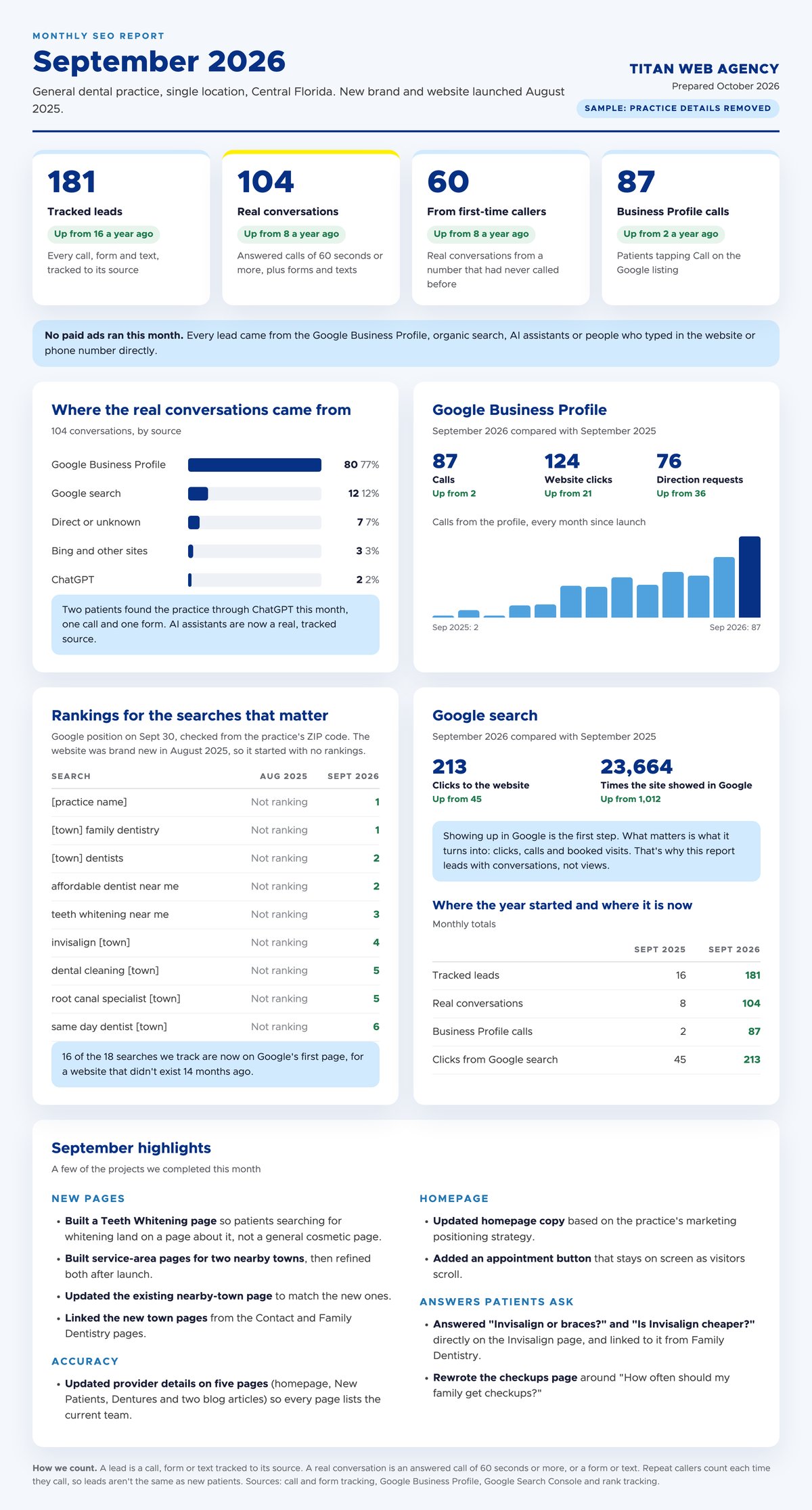
A real September 2026 report from a general practice in Central Florida, with identifying details removed.
Here's what to look for, in this report or anyone's:
- Leads and real conversations are separate numbers. This practice had 181 tracked leads and 104 real conversations, meaning answered calls of 60 seconds or more, plus forms and texts. Ask any agency where it draws that line.
- First-time callers get their own number. Repeat callers count each time they call, so leads aren't the same as new patients. A good report says so.
- Numbers are compared with a year ago. Month-to-month swings hide the trend. Here, tracked leads went from 16 in September 2025 to 181 in September 2026, and Business Profile calls went from 2 to 87.
- Leads are split by source. Two of this practice's leads came straight from ChatGPT. No paid ads ran, and the report says so. If an agency also runs your ads, ask for organic and paid leads split apart.
- Rankings start from a stated baseline. "Not ranking at launch" to "position 1" tells you something. A position on its own doesn't.
- The highlights connect to the results. A good report calls out the projects that moved the numbers, like new pages or updated homepage copy. It doesn't need to be a task list, but it shouldn't say "ongoing optimization" and nothing else.
Be wary of reports built mostly on numbers that look good but prove little by themselves: impressions, keyword counts, traffic with no lead data attached. They aren't useless. They just aren't the result.
Agency Insight: When we review a client's month, we start with real conversations compared with the same month last year. Raw leads swing with spam weeks and repeat callers. Answered calls of a minute or longer, plus forms and texts, are a much closer match to people who want an appointment.
Call two references
Ask for two current clients you can talk to. Then ask them four questions:
- How long have you worked with them?
- What changed in your new-patient numbers?
- What happens when you ask them a hard question?
- Would you sign with them again?
The third one tells you the most. You'll have hard questions eventually.
What it looks like when nobody checks
A dentist came to us after working with another well-known dental marketing company. He was frustrated that a competing office in his town used the same company, and that company had given both practices the same templated website. The title tags and headings matched, and much of the content was nearly identical.
The company was taking what worked on one site and copying it onto his. He was losing his brand and what set him apart.
When he decided to move to us, he found out he didn't own his Google Ads, Google Analytics or Google Tag Manager accounts. The company refused to hand them over, saying the contract didn't allow it. When we asked to see the contract, they wouldn't share that either. All they gave us was a few reports covering the past 90 days.
Those reports told the story. Google Ads was counting page views as conversions, so the account showed more conversions than clicks. They were bidding on irrelevant keywords, and there was no real tracking in place.
He assumed it was working. Once we peeled back the layers, it clearly wasn't.
We had to rebuild the Google Ads account, Google Analytics, Search Console and Tag Manager from scratch, and he lost years of Google Ads and Analytics history in the process.
The worst part? Nobody had ever checked whether any of it was bringing in calls. We set up call and lead tracking so he'd have a real answer going forward.
Almost every problem in that story is on the list below.
Dental SEO agency red flags that should stop the conversation
Some issues are fixable. These are the ones that should make you pause before you sign or renew.
The one I'd walk away over is the first one: an agency that owns your Google accounts and won't hand them over. Losing years of Google Ads and Analytics data is painful, and it sets the practice back.
The agency owns your Business Profile, website or Google accounts, or won't give you admin access. That makes an outside review nearly impossible and turns leaving into a mess. Require ownership from day one.
It guarantees rankings, page one or a set number of new patients. Google's own advice on hiring an SEO says no one can guarantee a number one ranking. Nobody controls the algorithm, your competitors or your reviews. A good agency gives you a careful forecast and explains the assumptions behind it. "Guaranteed dental SEO" is a sales line, not a service.
The contract locks you in for 12 months or more with no way out. An agency that's getting results doesn't need a long contract to keep you. At the very least, you should be able to leave if the agreed work isn't done.
Reports show only rankings and traffic, never calls or appointments. Rankings are a means. Patients are the point.
They can't explain what they're working on or why. You're paying for results. If nobody can tell you what the plan is, you may be paying for a campaign to sit still.
Every practice gets the same plan. Same pages, same blog posts, same monthly checklist. Your market, your services and your competition should shape the plan.
They work with your direct competitor, or won't say. Ask directly. Unlike some agencies, we don't work with two practices competing in the same market. It doesn't come up often, but how can you honestly tell Practice A you're doing everything you can for them while you're working just as hard for Practice B down the street? It's like a baseball coach coaching two teams in the same league. It just isn't right.
A cold email shows up with a list of problems with your website. Any competent agency can find something wrong with your website. It's the oldest trick in the book: a list of problems, a promise that fixing them brings rankings, a dig at your current agency and a low monthly price. No website is 100% perfect. And if that list came in a cold email, chances are no human ever looked at your site.
They call their method "proprietary" and won't explain it. Good SEO isn't a secret. It's a lot of specific, unglamorous work done consistently.
They insist on a full website rebuild before any audit explains why. Sometimes a new site is the right call. That decision should come out of an audit, not the sales deck.
What a fair SEO contract looks like
A fair dental SEO contract is easy to read. Look for:
- A written scope: what's included each month and what costs extra.
- A setup fee, if there's one, with a clear explanation of what it covers.
- Month-to-month terms, or at most a short first term with a reasonable notice period.
- A written handoff list: every login, every piece of content and every tracking account that stays with you if you leave.
I often say we want clients to stay with us because they want to, not because a contract makes them. All of our SEO and Google Ads management clients are month-to-month. If they cancel, we simply stop billing. If we aren't getting them the results they want, they should go somewhere else.
We're up front about this on every discovery call. SEO and AI search take time, and results usually aren't immediate. Even Google Ads takes a little while to get going. Nothing happens overnight, and we make sure clients know that going in, even if it costs us the sale. That's just how we do business.
Price is its own question, and it varies with your market and what you need. We break it down in what dental SEO costs. Whatever the number, compare it against the scope. A cheaper proposal that does less work isn't a better deal.
The Dental SEO Company Scorecard (a 30-minute check)
Use this with your finalists, or in a meeting with your current agency. Run all eight checks, score each one green, yellow or red, and read the pattern. Green means they showed you. Yellow means the answer needs a follow-up. Red means they refused, dodged or won't put it in writing.
- Open the accounts. Confirm your practice owns the website, Google Business Profile, Google Analytics, Google Ads, Tag Manager and Search Console.
- Ask what they'd fix first. Listen for a specific answer about your market, not a process.
- Look up two of their dental clients in Maps, searching from those clients' towns.
- Read one case study for starting point, timeframe, work and measured outcome.
- Read a sample report and find the new-patient leads.
- Ask what they're focused on and what they'd do next.
- Read the cancellation and handoff terms.
- Call one reference.
A few yellows are normal. Any red on ownership, reporting or proof means keep looking.
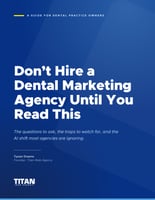
Free Guide for Dentists
SEO is one piece. Check the whole agency before you sign.
This post covers SEO. The free guide covers the rest of the decision: how patients pick a dentist before they ever reach your site, how to tell real proof from inflated promises, and the six questions to ask any marketing agency. Written by Tyson Downs after 15 years and over 100 dental practices.
Get the Free GuideHow Titan Web Agency handles dental SEO
Titan Web Agency works only with dentists. That focus means we've seen just about every way an SEO relationship can go wrong, and most of this guide comes from cleaning those up.
Every plan starts with dental questions. Which treatments do you want more of? What can your schedule take? Where do your new patients come from now, and where is the path from search to a booked visit breaking?
Every Titan Web Agency client owns their own Google Business Profile, website, Google Analytics, Google Ads account, Google Tag Manager and Google Search Console. If a practice ever leaves us, everything stays with them, and we'll help with the handoff. Our SEO and Google Ads clients are month-to-month, and we don't work with two practices competing in the same market.
Our reports lead with real conversations, not clicks. Calls and forms are tracked to their source, short calls and spam are filtered out, and the numbers are compared with where you were a year ago. The sample report above shows the numbers we put first.
If you're hiring for ads too, the same thinking applies. Here's how to choose a dental PPC agency.
And if you're comparing options now, see how we work as a dental SEO agency, then ask us every question in this guide.
How to choose a dental SEO company: frequently asked questions
Should a dental SEO company guarantee results?
No. Nobody controls Google's algorithm, your competitors or your reviews, and Google's own advice on hiring an SEO says no one can guarantee a number one ranking. A good agency gives you a forecast based on your market and explains the assumptions behind it. Treat any guarantee of rankings or patient numbers as a red flag.
Is it a problem if an SEO company works with other dentists in my area?
It can be. An agency working for two practices competing for the same patients can't give both its full effort, and it's tempting to copy what works on one site onto the other. Ask directly whether they work with anyone in your market. Titan Web Agency doesn't work with two practices competing in the same market.
Should I sign a long-term SEO contract?
You shouldn't have to. SEO takes months to show results, but a good agency keeps clients by getting results, not with a contract. If an agency insists on a long term, make sure you can leave if the agreed work isn't done. Look for a clear scope, a reasonable notice period and a written handoff list.
Who should own my practice's Google Business Profile?
Your practice should be the primary owner. The agency should have manager access, which lets it do the work without owning the listing. The same goes for your website, Google Analytics, Google Ads, Google Tag Manager and Search Console.
What should a monthly dental SEO report include?
Leads by source, with real conversations separated from spam and short calls. First-time callers counted on their own. Business Profile calls and website clicks. Rankings measured from a stated starting point. Year-over-year comparisons.
The bottom line
Choosing a dental SEO company comes down to one habit: judge them on what they can show you, not what they promise. Ask the questions, run the four checks and score your finalists. The right agency will pass easily, because it's used to showing its work.
If an agency can't, keep looking. And if you're hiring or thinking about switching, start with us. Book a free 15-minute call and ask us every question in this guide.



Tyson Downs is the founder of Titan Web Agency, a company specializing in marketing for dental professionals. With an impressive track record of working with over 100 dental practices, Tyson has a deep understanding of the unique marketing needs within the dental industry.